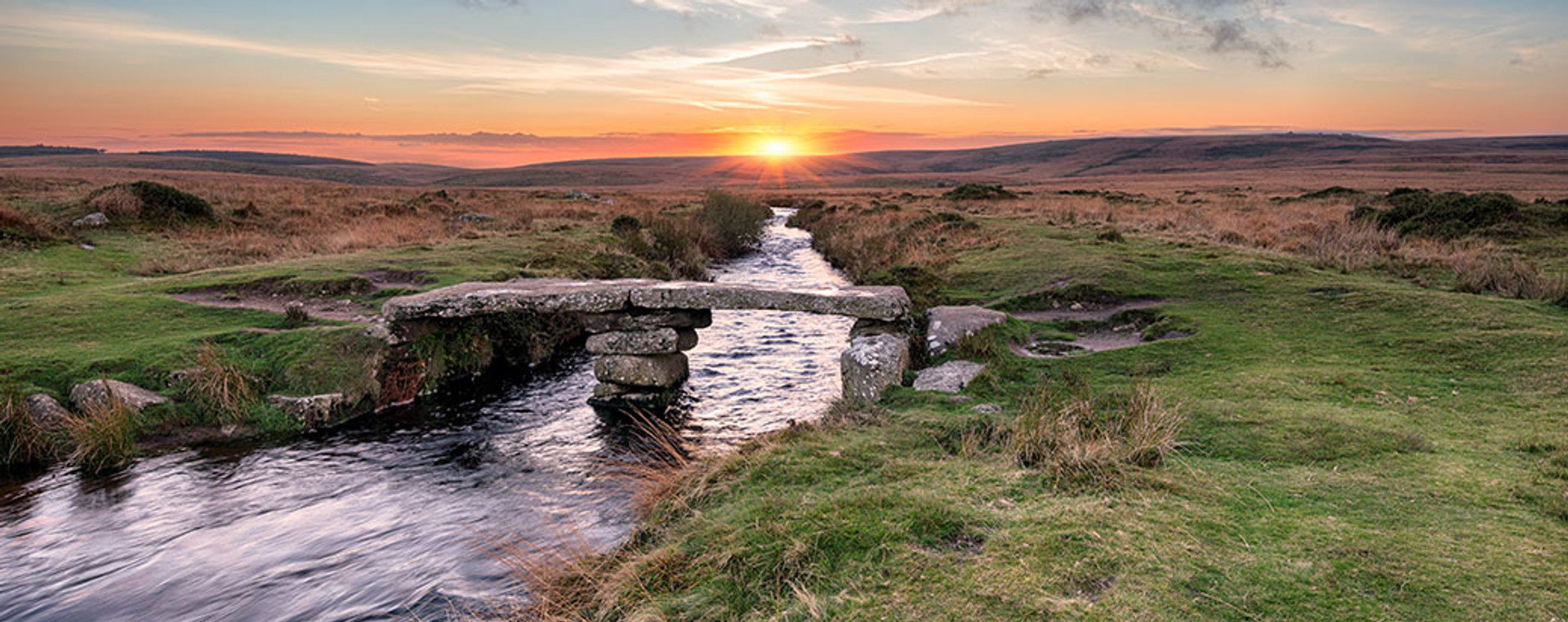
The justice of God, always holy and always adorable, has allowed a ferocious beast to enter our midst, to become the plague of our countryside, and to strike fear into our hearts.
Bishop of Gévaudan – 1764 sermon
Today I walked across the Margueride (a rocky granite plateau) from Langogne to Grandrieu. In contrast to yesterday, I didn’t meet another soul on the path all day. The day passed largely without incident. But if I’d been walking this route some 275 years ago between 1764-1767, it could have been a whole different story!
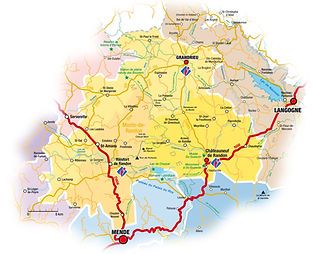
The Grand Hotel in Langogne had pretty much everything you could want from a hotel. Comfy double bed, airconditioning, shower with hot water. What it lacked was a restaurant. So I headed out into Langogne, which is a bit of a one street town, to find something to eat. It was Monday so pretty much everything was closed. The only exception was a restaurant called Le Gevaudan.
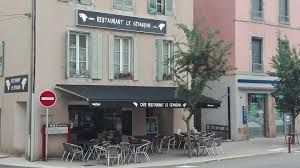
The restaurant, which featured what appeared to be a wolf’s head on its awning, was completely deserted. Over the street were sat six elderly folk on a bench looking at Le Gevaudan and shooting the breeze. Maybe this had had an an impact on the alfresco dining ambience. I’m sure the food was superb, but I decided to give Le Gevaudan a wide berth!
Eagle eyed readers of this blog will remember me discussing the Beast of Gevaudan when I walked the Chemin de Regordane last year. My current walk on the GR4 takes me through the same part of France. As not a huge amount happened today, other than my spending an hour in a café at Auroux supping a beer at lunchtime, I thought I’d revisit the story of the Beast of Gévaudan.
In French folklore, the Beast of Gévaudan lies somewhere between the Surrey Panther, the Beast of Exmoor and the Loch Ness Monster. Between 1764-7 it killed more than 100 people and injured as many as 300 more. It’s attacks became the focus of a global media storm that spread as far as North America!
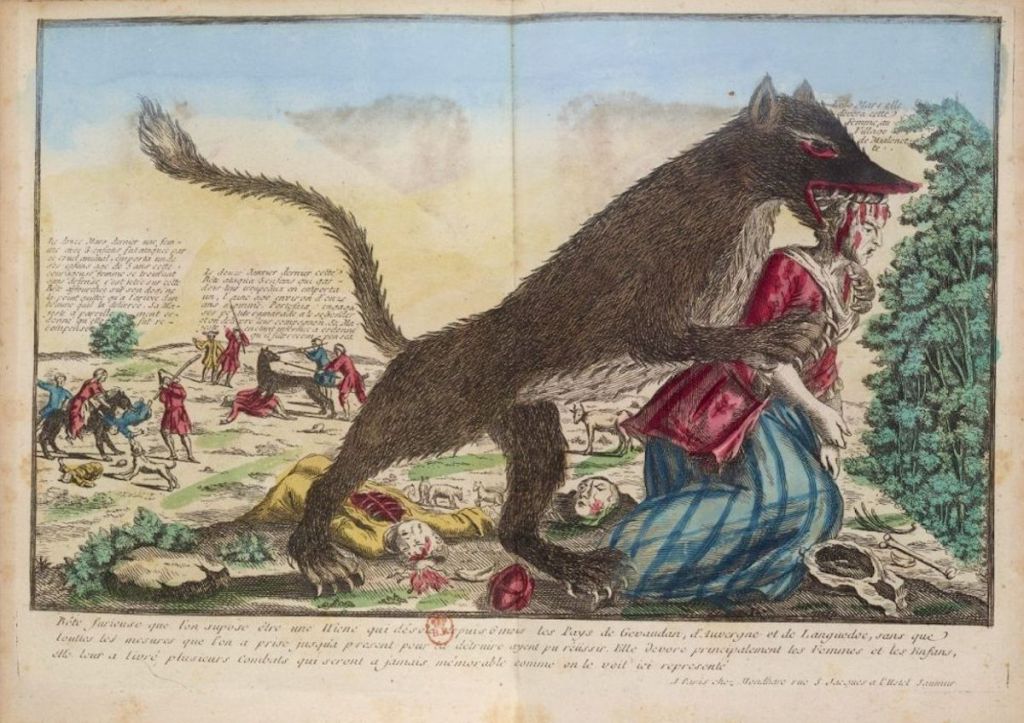
The monster’s first victim was Jeanne Boulet, a 14-year-old girl watching her sheep. Her death was followed by others, almost exclusively women and children. Throughout 1764, the brutal attacks—victims with their throats torn out or heads gnawed off—riveted France. The violence was so shocking, news of it traveled from the countryside all the way to the royal palace in Versailles. What was this beast of Gévaudan, and who could stop its reign of terror?
The Gévaudan was just as mysterious as its monster. It had the reputation for being a remote, isolated backwater where the forces of nature had not been full tamed, where the forests were indeed enchanted.
France of 1764 was in miserable condition. The Seven Years’ War had ended a year earlier, with France suffering numerous defeats at the hands of the British and the Prussians. The king, Louis XV, had also lost the bulk of his country’s overseas empire, including Canada. The economic situation was dire and the country was in disarray. Despite the carnage the beast wrought, it served as a perfect foe for a nation with something to prove, a country in need of a cause to rally around.
The beast and its victims might have gone virtually unnoticed if not for a burgeoning press. Because political news was mostly censored by the king, newspapers had to turn to other sources of information—and entertainment—to bolster subscriptions. François Morénas, creator and editor of the Courrier d’Avignon, used a new type of reporting called faits divers—stories of everyday incidents in small villages similar to today’s true crime—to tell the tale. His reportage in particular transformed the beast from a backwater calamity into a national affair.
Take Jacques Portefaix. The young boy and a group of children were out in a meadow with a herd of cattle on January 12, 1765, when the beast attacked. Working together, they managed to scare it off with their pikes. Portefaix’s courage was so admired that Louis XV paid a reward to all the children, and had the boy educated at the king’s personal expense.
Individuals may have had some success defending themselves, but official hunters had none. In February 1765, the d’Ennevals, a father-son hunter duo from Normandy, announced they would travel to Gévaudan to eliminate the beast. Jean-Charles, the father, boasted he’d already killed 1,200 wolves, relevant information assuming the predator was, in fact, a wolf. But no one was sure of that. “It is much bigger than a wolf,” wrote Lafont in an early report. “It has a snout somewhat like a calf’s and very long hair, which would seem to indicate a hyena.
Duhamel described the animal as even more fantastical. In his words, it had a “breast as wide as a horse,” “a body as long as a leopard’s,” and fur that’s that was “red with a black stripe.” Duhamel concluded, “You will undoubtedly think, like I do, that this is a monster, the father of which is a lion. What its mother was remains to be seen.”
Other witnesses claimed the beast had supernatural abilities. It could walk on its hind feet and its hide could repel bullets and it had fire in its eyes and it came back from the dead more than once and had amazing leaping ability.
Whatever its origins or appearance, the hunters were determined to score their prize. But again and again, they failed. The d’Ennevals eventually gave up at which point the king sent his own gun-bearer and bodyguard, François Antoine. Along with his son and a detachment of men, Antoine traipsed around the forested countryside in search of the beast. At last, in September 1765, he shot and killed a large wolf. He had the body sent to the court at Versailles, received a reward from Louis XV, and accepted the villagers’ gratitude.
Two brief months later the attacks recommenced.
Two brief months later the attacks recommenced.
For another 18 months, something continued to stalk the villagers of Gévaudan, with a reported 30 to 35 fatalities in that period. The king, believing the beast had already been slain, offered little aid.
With no assistance coming from outside the region, locals took matters into their own hands—an option that may have been wiser from the beginning, since the previous hunters were unfamiliar with the landscape and had trouble communicating with locals.
Local farmer Jean Chastel had been involved in a previous hunt, but was thrown into prison by Antoine for leading his men into a bog. But his past crimes turned to bygones when he managed, at last, to bring the creature down with a bullet on June 19, 1767.
Luckily I didn’t meet any of the ancestors of the Beast of Gévaudan on my walk from Langogne to Grandrieu. I passed a rather incongruous 18 hole golf course outside Langogne and then circumnavigated a huge lake that was half empty.
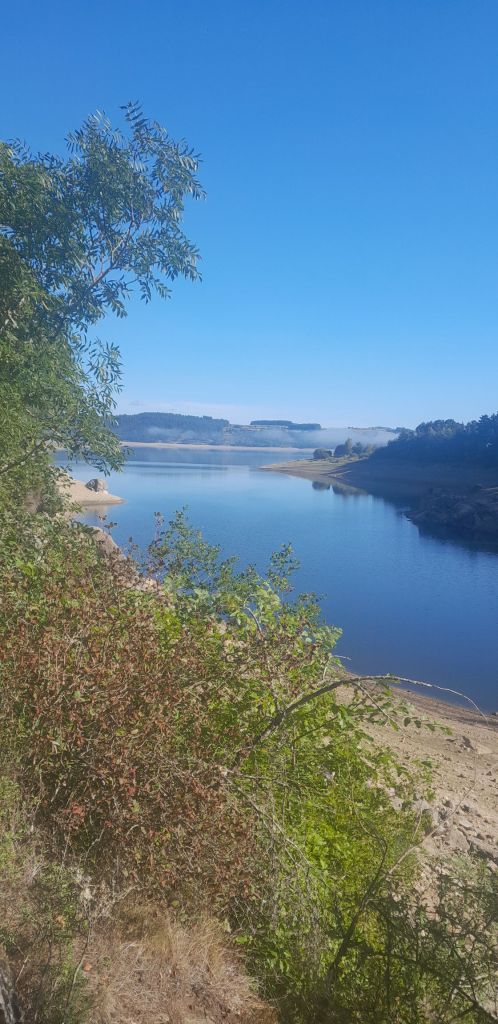
The countryside was considerably greener than I had expected and the summer pastures were being happily grazed.
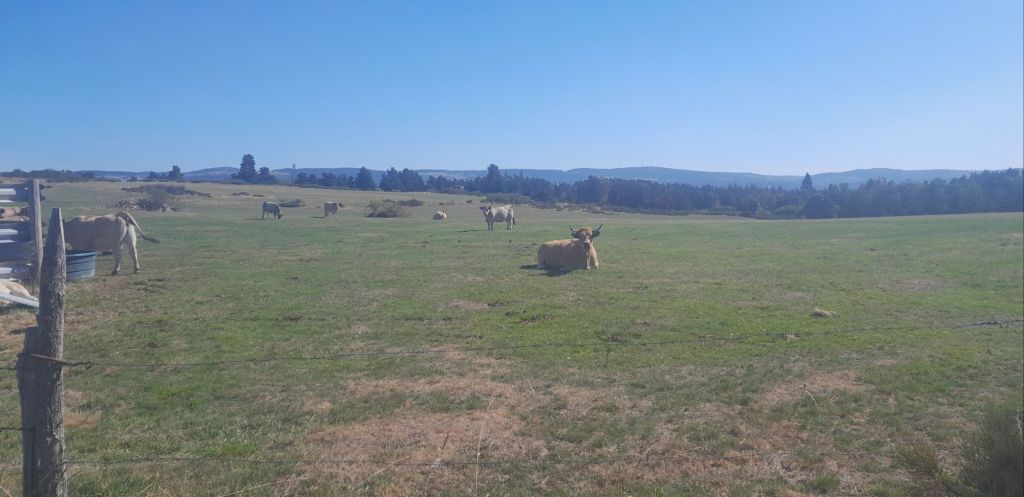
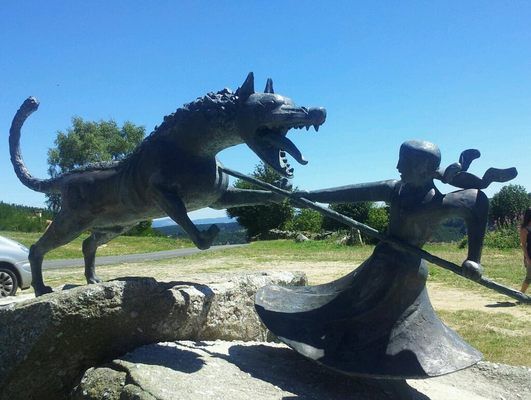
I made it safely to Grandrieu shortly after 4pm. Nowadays The Beast of Gévaudan does for local tourism what Nessie does in the Scottish Highlands. It’s quite a come down for an animal that was possibly the most destructive of human life in recorded human history! Thankfully they have yet to start selling soft toys of the Beast in these parts!

 Pilgrim's Progress - Long Distance Walks in Europe and the UK
Leave a comment