‘A horse, a horse, my kingdom for a horse.’
Richard III Act 5 Scene IV – William Shakespeare
Today was an early start so that I could fit in an appointment in Chilham and make it to Canterbury in good time to look around the town and Cathedral.
I made my way back onto the PW via Westwell to Eastwell Park which stood at the end of an impressive tree lined avenue.

As I walked through the grounds I got chatting to Paul ( a groundsman) and ‘Creepy’ from the estate security team. The previous day a group of 80 pilgrims from Southwark who were on a pilgrimage to Canterbury over the Bank Holiday weekend, had been feted with tea and cakes. I had come a day too late they joked!

I was more interested in locating the memorial to Richard Plantaganet in the graveyard of the ruins of St Mary’s Church. Creepy escorted me back down the drive and ushered me into the graveyard where I located the memorial to Richard Plantaganet.
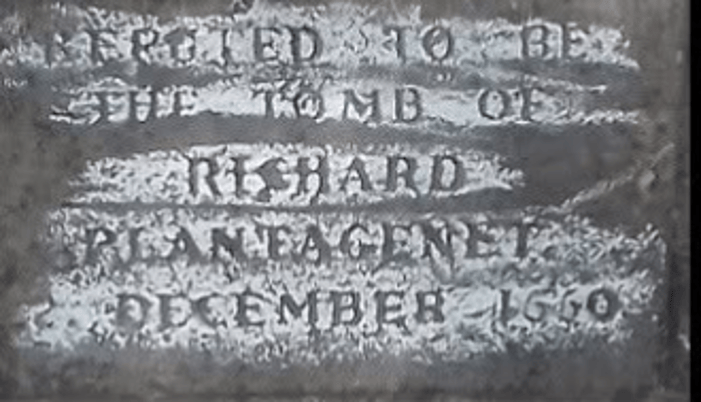
Richard Plantaganet is reputed to have been the illegitimate son of King Richard III who lost his life at Bosworth Field in 1485 and has recently been discovered to have been buried beneath a car park on Leicester. According to local folk lore, Richard Plantagenet was brought up without knowing who his parents were but was boarded with a schoolmaster who taught him Latin, a sign of someone being educated according to his status.
One day he was taken to the battlefield at Bosworth where the king embraced him and told him he was his son. The king told the boy that, if he won the battle, he would acknowledge him as his son. If he lost, he told the boy to forever conceal his identity. After the king was killed in battle, his son fled and ended up at Eastwell, working as a gardener and bricklayer for Sir Thomas Moyle, the lord of the manor. It is thought he deliberately lived an inconspicuous life because people claiming to be descendants of the royal family were summarily executed during the reign of the Tudors. Parish records suggest Richard was 81 when he died in 1550. This was an extraordinary age for somebody in the 16th century to live to and it would have made him 16 years old at the time of his father’s death at Bosworth.
As I walked through woodland towards Chilham, I mulled over all the fascinating places I had visited, the interesting people I had met, the happy unforeseen chance encounters that had occurred and the many miles I had walked since leaving Winterbourne Stoke with Olivia just 10 days ago.
By my rough reckoning, I’d averaged 20 miles a day. By historical standards, not too shabby – Roman legionaries would routinely march 15 miles a day, although they were also wearing heavy armour and sandals and walking on rough muddy roads. Hmm. Maybe my daily achievements weren’t so impressive after all.
And then of course there was King Harold’s army which, in the course of 10 days, marched 180 miles from Sussex to York, fought and defeated a Viking army at Stamford Bridge and then, with barely time to draw a breath, marched 180 miles back south in 4 days to fight the Norman army at Hastings. That equated to a staggering 35 miles a day and firmly put my own efforts in the shade!
My walk to Rome was inspired by Harry Bucknall’s travelogue ‘Like a Tramp, like a Pilgrim – on foot across Europe to Rome’. In the book, Harry recounts an amusing episode when he dropped in to Chilham Castle to stay with Theresa Wheeler, the owner. Sadly Theresa and Stuart died recently and Chilham Castle has been sold to a mystery buyer for £15m!
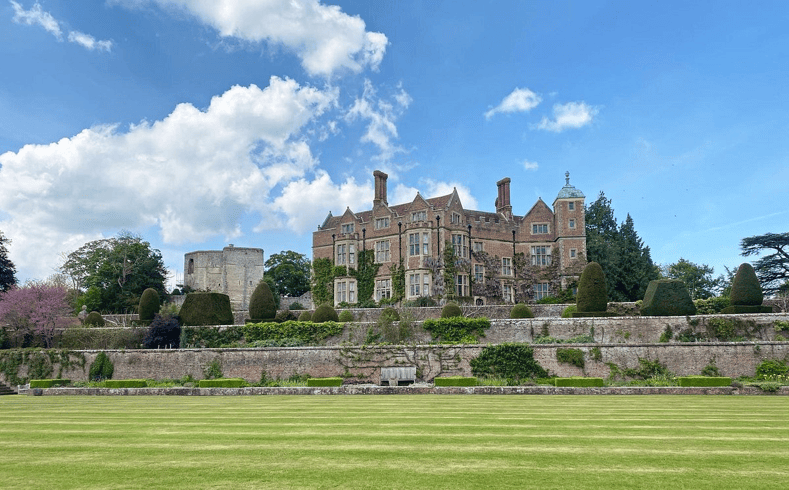
So dropping in to Chilham Castle wasn’t really an option but I did the next best thing – I dropped in to see the brother of a friend who lives in a lovely Queen Anne vicarage behind the Church.
As I knocked on the door, I was greeted by a boisterous Vizla called ‘Chica’ followed by Anthony and his Dutch wife. ‘You’d better not leave your boots and hat by the door Jonathan’ I was advised. ‘ Chica’ will make off with them and bury them somewhere’. I followed their advice and carefully placed my kit behind the door to the cellar!
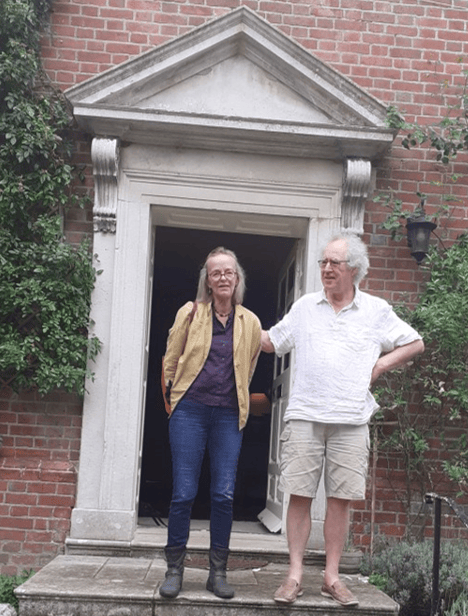
Anthony and his wife kindly made me some coffee and offered to cook me a poached egg to ‘keep the wolf from the door’ and sustain me until I reached Canterbury.
Anthony had had a fascinating life. Born in Argentina, his family had been involved in the building and running of the Argentinian railway network at a time when there was an extensive British community in the Argentine.
As I sat eating my poached egg on toast, Anthony regaled me with amusing anecdotes of his childhood growing up in Argentina ( he narrowly avoided conscription into the Argentine army during the Falklands Conflict!) as well as giving me a fascinating overview of the founding of the Argentine Republic by Simon Bolivar and the exotically named Bernardo O’Higgins.
I mentioned that I had once travelled around Argentina and Chile during a trip which involved the attempted ascent of Mount Aconcagua in 1996 – the first of many interesting connections we shared!
Since retiring from a career as a barrister representing the Home Office, Anthony had turned his attention to theology and bee keeping, a hobby shared by my grandmother who kept bees on Bodmin Moor in the 1930s and learnt her craft from the legendary Brother Adam at Buckfast Abbey. ‘Ah yes, Brother Adam’, Anthony smiled and added mischievously ‘ Of course his bees were imported from Italy. My bees are quite different – many of them are the progeny of a large swarm which I rescued from the tower of the church here in Chilham. They are extremely productive – last year I harvested over 60 jars of honey from their hives!”.
On the final stretch to Canterbury, I did finally spot a solitary hop field. However, the majority of the landscape was dominated by acres and acres of apple orchards. Kent is still ‘The Garden of England’, although the apples and pears aren’t picked by students like me anymore! At Chartham Hatch there was a village of standing caravans for migrant seasonal workers from Eastern Europe. I only saw one chap chatting away on his phone. What impact Brexit has had on fruit picking operations in the area I was unable to ascertain, but it is unlikely to have been positive.
Until relatively recently Kent was the largest producer of hops in the world! Hops are an essential ingredient in the production of beer, helping to preserve the beer in good condition and give it a bitter flavour. Imported hops were introduced in London in the 15th Century, to brew bittered beer instead of the traditional unhoped ale common in England. The growing of hops in Kent was introduced by Huguenot Refugees during the Reformation. The first documentary evidence of oasts built to dry hops in England appears soon after.
Hops are an essential ingredient in the production of beer, helping to preserve the beer in good condition and give it a bitter flavour.
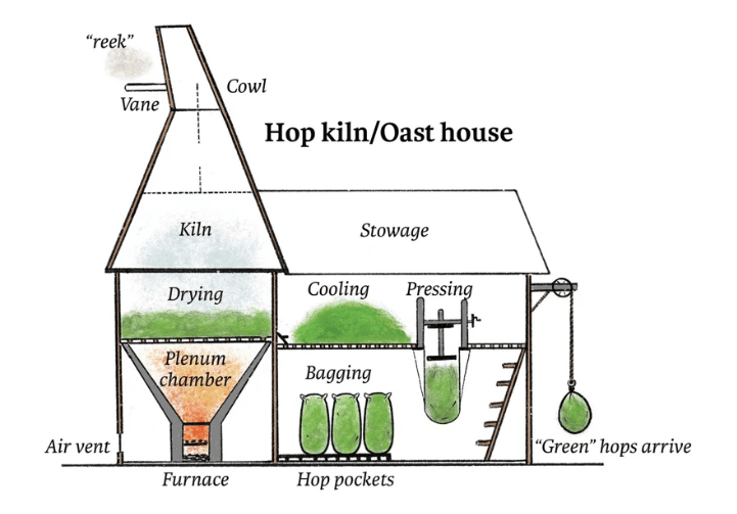
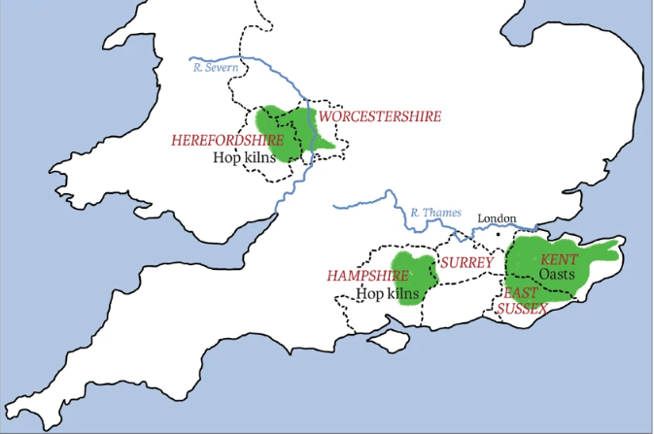
Small-scale, local hop growing spread rapidly to many counties of England, mainly in the south and east, up to Nottinghamshire and down to Dorset. Attempts to develop a hop industry in Scotland, Wales and Ireland were defeated by the weather and topography. Over time, the industry became concentrated in three favourable regions: Kent/East Sussex, Hampshire/Surrey and Herefordshire/Worcestershire. The buildings in each area had a strong regional identity. By the later 19th century, Kent was producing 75% of England’s dried hops. In the present century, West Midlands production has overtaken Kent and Sussex for the first time.
English hop farming declined throughout the 20th century, falling to 1% of world production. Hop acreage dropped from over 77,000 acres in the 1800s down to about 2,000 to 2,500 acres today. Today there are fewer than 60 commercial hop growers left in the UK. In the 1980s I used to spend September hop picking at a farm near Goudhurst in Kent. The work was hard – we started work at 7am and finished at 5pm but the student pay was pretty good, and we had some fun times with some of the East End families who used to come down to help out with the hop picking.
I still remember an incident which occurred 40 years ago when I was returning to my parents by train after completing a month of hop picking in Kent. I remember boarding the train at Tonbridge with the same hop picking clothes that I’d been wearing for the previous month. It was a Saturday morning, the carriage was packed and I struggled to find a seat. Strangely, within 10 minutes of my boarding the train, the carriage had entirely emptied of passengers. I thought little of it at the time and settled into a book for the journey. When I reached my parents’ home, no sooner had I entered the front door than I was frog marched to the bathroom for a shower, my clothes were unceremoniously removed and placed on the bonfire for immediate incineration. Apparently, I stank to high heaven, but being anosmic (having no sense of smell), I was blissfully unaware of the stink I was causing!
As I approached Canterbury I passed the iron age hill fort at Bigbury, the scene of Julius Caesar’s first major battle with the native British after his invasion in 55BC. This part of England has a lot of history attached to it – on Sunday I passed the spot where the Romans had crossed the river Medway during their successful invasion of Britain in 43 AD.
Just before reaching Canterbury Cathedral, I popped into the Church of St Dunstan from whence King Henry II in 1174 exchanged his regal robes for a sack-cloth shirt and crawled on his knees in penance to Canterbury Cathedral to atone for the murder of Thomas Becket in 1170. The church also holds the head of Thomas More. After refusing to take the Oath of Supremacy, More was convicted of treason and beheaded. His head was placed on a pike on London Bridge. More’s daughter, Margaret Roper, who lived almost opposite St Dunstan’s Church, rescued her father’s head from London Bridge and brought it to Canterbury. It was interred in a crypt where it safely resides to this day. All of this interesting information was imparted by the curate, Jenny Walpole, whom I encountered as I left St Dunstan’s. ‘Good luck with your walk to Rome’ she said as I headed off on the final few yards of my pilgrimage to Becket’s shrine.
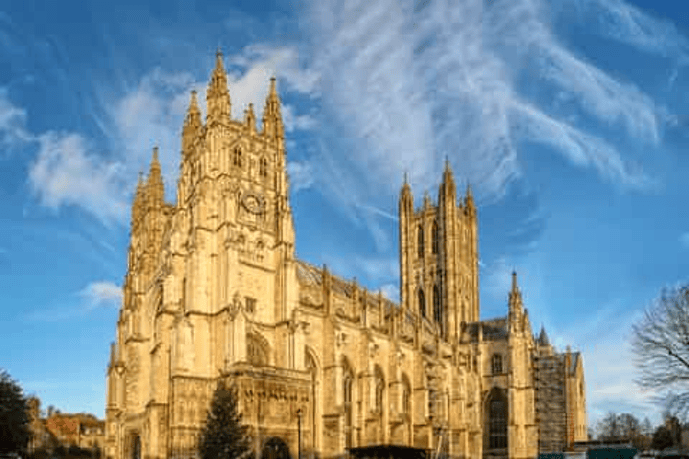
At Canterbury Cathedral I made my way to the spot where Becket was savagely murdered by four knights who hacked his skull to smithereens as he emerged from Mass on the evening of 29 December 1170. Over the next 30 years a shrine was built to the Saint which historians estimate was visited by over 100,000 pilgrims each year. The memorial was built in Trinity Chapel but was destroyed during the Reformation in 1538. It was strangely moving to stand in silent contemplation, commemorating the past and wondering how far I would get on my own pilgrimage from Canterbury to Rome along the Via Francigena. It seemed like the beginning of another journey. The journey of a thousand leagues, begins with a single step.


Leave a Reply