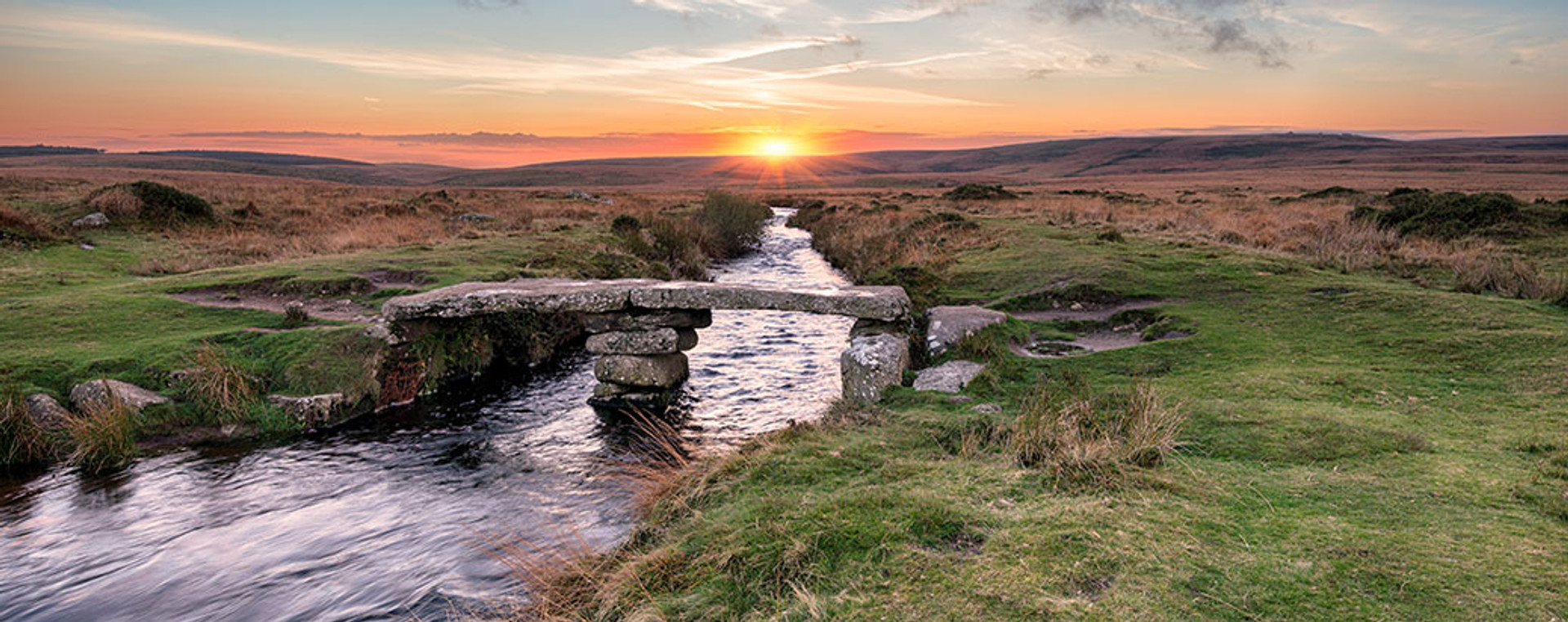
Who, or why, or which, or what, Is the Akond of SWAT?
The Akond of Swat – Edward Lear
I found myself reciting the first few verses of Edward Lear’s famous poem ‘The Akond of Swat’ as I woke up this morning and pondered the question, who are the Order of Carmelite Friars and why do they have a Priory in the middle of Kent?
The Carmelites are one of the four great mendicant orders of the Roman Catholic church. Founded in the Crusader States near Mount Carmel in 1155, they first came to Aylesford in 1242. As with other mendicant orders like the Franciscans, their primary purpose is to care for the poor and downtrodden in society. How Carmelites serve is not set in stone. As friars, they respond to the needs of the Church in a variety of ways, always following in the footsteps of Jesus Christ.
As I was leaving the Priory I encountered a large gaggle of people parading a portrait of Jesus Christ and heading towards the main chapel. The Indians from Gillingham were not amongst them, but I did overhear some very animated Irish voices chatting away in the throng.

For most of the day the weather was overcast with leaden skies and there was a constant threat of rain in the air. Consequently, there was a lot of time to ponder abstruse subjects such as the identity of the Akond of Swat! The Akond of Swat was a prominent 19th century religious leader, Sufi mystic, and political figure who lived in the Swat valley in northwest Pakistan which I passed through in 1990 when travelling the Silk Road from Agra to Beijing. More of a mystery, is why Edward Lear decided to immortalise this obscure individual in humorous verse with such classic lines as Does he beat his wife with a gold-topped pipe, When she let the gooseberries grow too ripe and Does he live on turnips, tea or tripe? Does he like his shawl to be marked with a stripe?
I did pass quite a few oast houses during the day, which definitely reminded me that I was in Kent as did the familiar greeting I was given by a number of passers by – “youarightthen“
But as for hop fields, much to my disappointment, there was neither sight nor sound of them. In contrast I saw a large number of vineyards during the day.
For most of the day I stuck to the original path that the pilgrims would have taken on their way to Canterbury in the time of Chaucer.
The pub signs were a constant reminder that I was on the original pilgrim route. I passed the Black Horse Inn at Thurnham and dropped in to the Dirty Habit pub at Hollingbourne for a pint of diet Pepsi.
The Dirty Habit pub was once called the Pilgrims Rest. The present name is derived from the clothing of monks who worked the monastic farmland and vineyards.
The pub was packed with people enjoying the Bank Holiday and there was barely standing room at the bar for me to drink my Pepsi!

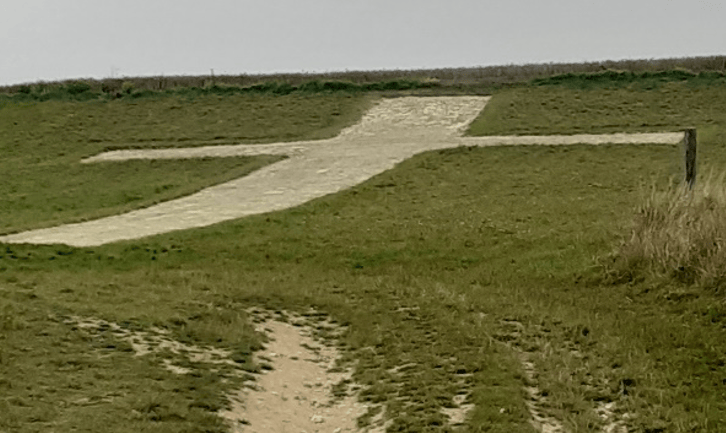
At Lenham, en route to Charing, I came across a large cross cut into the hillside which commemorates those from the village who died in World War 1 and 2.
In the distance the Kentish Weald stretched to the south of the Pilgrims Way. From the old English word wald, meaning forest, the term Weald was used to describe the ancient wilderness of grassland, scrubland and forests that stretched across the southeast of England from the Kent marshes to the New Forest in Hampshire. The Kentish part of this landscape was known as the Forest of Anderida to the Romans during their occupation. The Domesday Book of 1086 showed the Weald to be the largest remaining area of woodland and heath in the whole of England at the time. For generations the Weald of Kent comprised a scattering of small settlements, with cattle and pigs grazing loose in the woods. But by 1200 much of the Weald as we know it had already formed, with most of the villages, towns and farmland we would recognise today. It was during the Middle Ages that the Weald became one of the wealthiest areas in the country, thanks its trees and iron ore. During the Tudor and early-Stuart eras, the Weald was the main iron-producing region in Britain. Local iron ore had been used since the Iron Age but by the mid-1500s there were more than 100 furnaces and forges, employing huge numbers of the local population. The furnaces were kept blazing with wood from the surrounding forests, changing the very landscape.
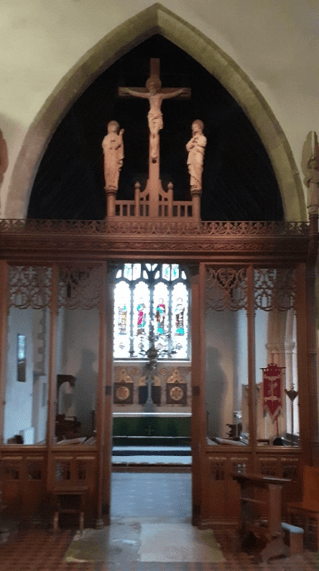
I finally made it to Charing at around 4.30pm and nipped in to the church, which amazingly was open and had a pilgrim stamp for my passport. Charing was a day’s ride from Canterbury for pilgrims in the middle ages. The Bishop’s Palace in the village was one of Becket’s favourite stop overs en route to Canterbury. Charing was also a pilgrimage site in it’s own right – it displayed the block on which John the Baptist was beheaded. The relic was brought back from the Holy Land by Richard I after Becket’s murder. It survived the Reformation only to be lost in a fire in 1590!
For those of you who are wondering if there is any connection between the village of Charing and Charing Cross in London, the answer is yes. Both are derived from the old English word ‘cerring’ for a bend in the road or river.
My final destination was the Premiere Inn at Ashford North which involved a 30 minute walk along the busy A30. Never was a warm bath more welcome particularly as the room and facilities at the Aylesford Priory had been a bit disappointing. The communal loo didn’t flush properly, there was no hot water in the communal shower, a notice in my room advised that on no account should I drink the water from the tap and at breakfast my attempt to obtain a second sausage was rebuffed with the remark ‘ Those two sausages are reserved for two other guests.’
I think I will enjoy my supper at the Premiere Inn this evening!


Leave a Reply