The hop that swings so lightly
The hop that shines so brightly
Shall still be cherished rightly
By all good men and true.
Hop picking poem – anonymous
The day got off to a slightly disappointing start when I awoke to find that my washing had failed to dry overnight! Thankfully I have brought a sufficient quantity of safety pins to attach them to my rucksack. I must just that I remember to hide them away before I meet the Revd Julian Hubbard at Compton this afternoon. It is what I believe is called, airing one’s dirty laundry in public!
Today there are just 56 farms in England which produce hops, but 150 years ago the countryside between Alton and Compton was festooned with hop fields.
As a university undergraduate I used to spend the last month of the long vac working on a hop farm in Kent near Cranbrook. It was back breaking work for the month of September from dawn to dusk with a group of fellow students and a family from Croydon who came hopping every year with their grandfather – originally from the East End of London he could remember the time when a Messerschmitt 109 fighter had strafed the hop pickers in the fields during the Battle Of Britain in 1940 before the German fighter plane had been shot down by a Spitfire. Talking to him about his experiences ‘hopping’ was like reliving history. So hops and hop farming hold a special place in my heart and I was on the look out for vestiges of hop farming on my route from Alton to Compton.
In 1867 Alton was the scene of a gruesome crime ( yes another one!) which involved a murder on a local hop farm and provides the origin of the expression ‘ Sweet Fanny Adams’.
Fanny Adams was an eight-year-old English girl who was murdered by solicitor’s clerk Frederick Baker on 24 August 1867 in Alton. The murder itself was extraordinarily brutal and caused a national outcry in the United Kingdom. Fanny was abducted by Baker and taken into a hop garden near her home. She was then brutally murdered and her body cut into several pieces; some parts were never found.
I searched high and low for vestiges of the regions hop farming heritage and did eventually manage to identify a converted hop kiln near Farnham.

However, for most of the day’s walk there were precious little evidence that hops were currently being grown in the area. In fact I saw more solar farms than hop fields on my walk today!
Finally, however, as I reached the village of Puttenham outside Guidford, I found some hops being grown, reintroduced to the area in 2018 in response to demand for the ‘Fuggle’ variety of hop from the UK craft brewing industry.

Near the village of Bentley I saw a lone oak tree on a ridge, standing like a loyal sentinel overlooking the pilgrim path in the valley below. I paused, transfixed by its beauty. Did it look slightly like a hedgehog on a pogo stick I mused. As I stood there, lost in my thoughts, a lissom blonde jogger in an orange top and leggings appeared from nowhere and exclaimed, ‘Beautiful isn’t it. I love that tree’ as she sped past like an arrow.

Oak trees have a curious nature. Legend says that, as a deciduous tree, it’s root system mirrors the tree above ground. Imagining those roots extending 30 to 40 feet into the earth, anchoring the tree and helping it withstand the ravages of the seasons. It’s a vivid reminder of where we come from, and how the seasons of challenge and growth that we survive become the roots that allow us to endure difficult times and thrive in others.
In the village of Froyle I was overwhelmed by the sheer number of opulent mansions with immaculately maintained gardens. There was a definite whiff in the air of stockbroker belt money! Hops used to be grown around Froyle. Local records suggest that in 1800 there were 141 acres of hops under cultivation and an 1855 directory states that ‘there are hopyards on all the farms’, nowadays there don’t appear to be any! Froyle has gone from being a village in the hop picking belt to a village in the stockbroker belt!
In Bentley, I came across another tree – a yew, estimated to be 350-500 years old, propped up on wooden supports in the village church yard. Its ancient branches arched over the surrounding tombstones like a spider’s web. It was a sobering thought that the tree must have been around when Jane Austen’s favourite brother Henry was the church curate in 1824.

I managed to acquire a pilgrim stamp at Puttenham church. It was humbling to think that the 12th century Norman archway above the entrance would have been standing when Becket was murdered in 1170.
Passing Farnham Castle brought back memories of attending an induction course there with HSBC before going out to work in Dubai in 1986. It seems like a lifetime ago! I believe it is a wedding venue nowadays.

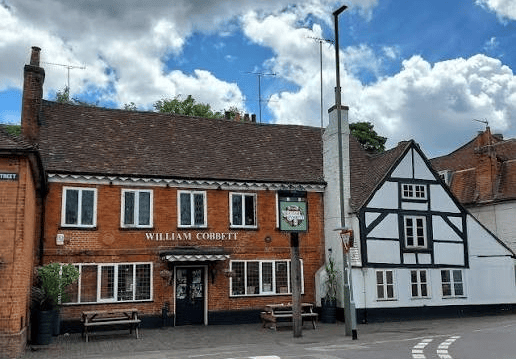
I stopped off in Farnham to buy a sandwich. The 18th century author of Rural Rides and social reformer William Cobbett was born in the town and once described it as ‘the neatest town in England, and, I believe, in the whole world.’ It still feels that way today with its up-market designer shops lining the busy high street.
Cobbett was born at his father’s pub, the Jolly Farmer (now called the William Cobbett). He started work as a farm labourer while still a child which may have formed his lifelong interest in the plight of rural workers. Aged 20, he moved to London and escaped his hated job as a clerk by joining the army. Rising in the ranks, Cobbett was stationed for eight years in Nova Scotia, Canada, he ended up a Regimental Sergeant Major and two years later published The Soldier’s Friend, an indictment of the army.
Back in England, Cobbett became a farmer in Botley where he lived with his wife, Ann, and seven children. Unfortunately, he went bankrupt and lost the farmhouse but continued to be based in Hampshire. His activism eventually led to him being arrested for sedition and spending two years in Newgate prison during which time, of course, he continued to write and publish pamphlets.
The Rural Rides took place with his son from 1822 to 1826; each one published individually and then together in book form in 1830. The book gives a vivid description of the early nineteenth century countryside and its people with particular reference to rural hardship. He remarked on growing hops when he travelled through Selborne in August 1823. A farmer told him that ‘he did not believe there was a more unhappy place in England’. There were many factors at play, but one of them was the state of the hop crop. He wrote: ‘The bines have scarcely got up the poles; the bines and the leaves are black, nearly, as soot… and covered with lice.’ This was probably due to mildew.
Cobbett reported that ‘the hops are equally bad at Alton, Froyle, Crondall and even Farnham’ and elsewhere in the country. He used the hop duty levied by the government to fire a broadside on ‘vile paper-money’ and investments in stocks and shares. He said that placing a bet on the amount of hop duty – which many people did at the time – was as reprehensible as using a ‘gambling agent, whom [people] call their stockbroker’.
In later life, Cobbett became involved in politics, exposing political corruption and being responsible for the institution of Hansard. In 1832 he was elected MP for Oldham and re-elected in 1835. William Cobbett died the same year. 8,000 people (more than the population of Farnham at the time!) attended his funeral in Farnham.
The best bit of the day was saved for last. Prior to embarking on my walk, I had contacted several churches on my route to see whether they would be willing to accommodate me on my walk. One of the first to reply and offer me a bed for the night was the Revd Julian Hubbard, the rector of Compton near Guildford. So, late in the afternoon, we met outside his magnificent Grade 1 star Church of St Nicholas and he proudly gave me a tour of the stunning church which is undoubtedly one of the finest Norman churches in the south of England.
Its Saxon tower alone would make the church special, but what makes it both unique and mysterious is its two storey sanctuary, possibly unique in the UK.

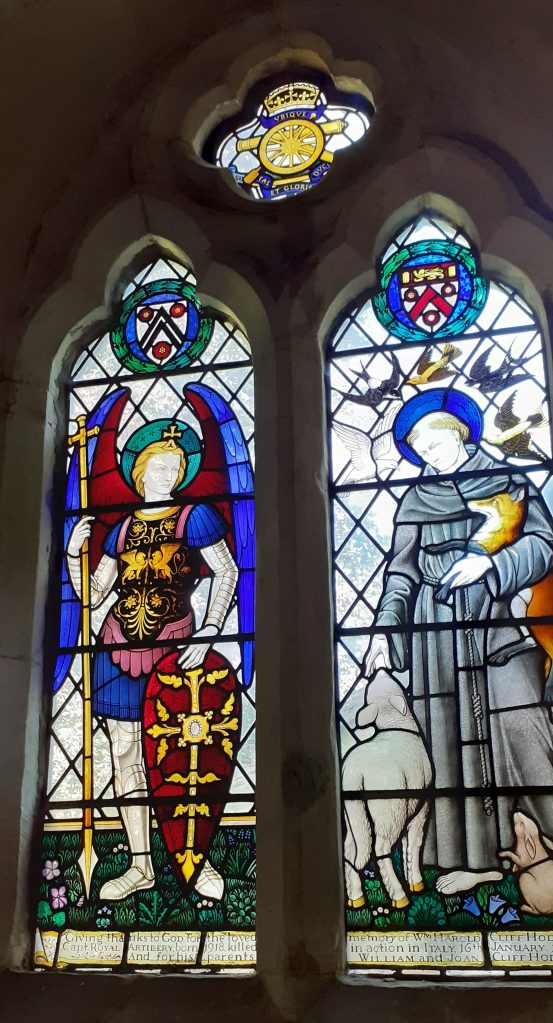
The nave is adorned with early medieval wall paintings in the shape of lozenges. The carvings on the arches in the nave are intricate and incredibly well preserved. Carved from clunch limestone they almost look as though they were made yesterday. Another beautiful feature Julian pointed out is a stained glass window commemorating the death of a parishioner aged 26 in Italy during WW2. Golden Orioles ( nowadays hardly seen in the UK), a hare and a fox are all beautifully depicted. All in all the church is in immaculate condition and its almost impossible to believe that it dates back nearly 900 years.
It was a huge treat being welcomed in to Julian’s home and to meet his family. Upon arrival I took my boots off, slumped into a sofa and spent an enjoyable hour watching the cricket on Sky TV as well as chatting about Julian’s time as Rector of Jesus College Oxford and Canon of Christ Church Oxford, his time in Israel and his experiences of walking the Sentier de Saint Jacques from Le Puy as well as the Spanish Camino. Julian rounded off the evening by cooking up a delicious curry for supper.
I couldn’t have asked for a warmer welcome and a better end to the day.


Leave a Reply