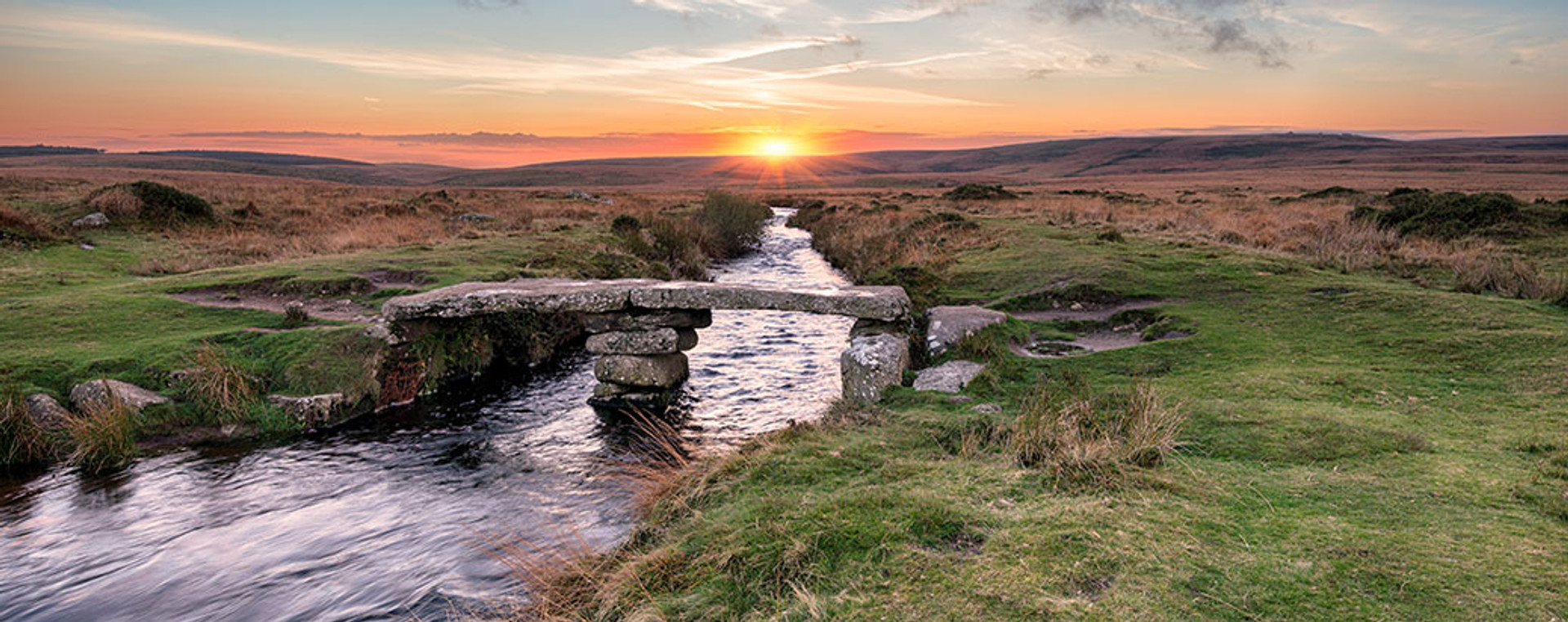
And I on my volcano edge Exposed to ridicule and hate Still do not dare to leap the ledge And smash to pieces on the slate.
John Betjeman – Tregardock
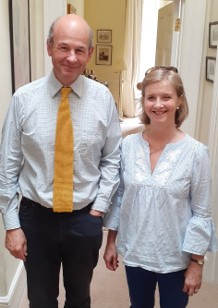
We were joined for breakfast at Julian’s by Richard, an old beagling friend of mine who lives in the same road as Julian and knows him well. It’s a small world or at least the beagling world is! As soon as he heard of my planned walk, Richard contacted me and asked if he could join me on the stretch between Compton and Guildford.
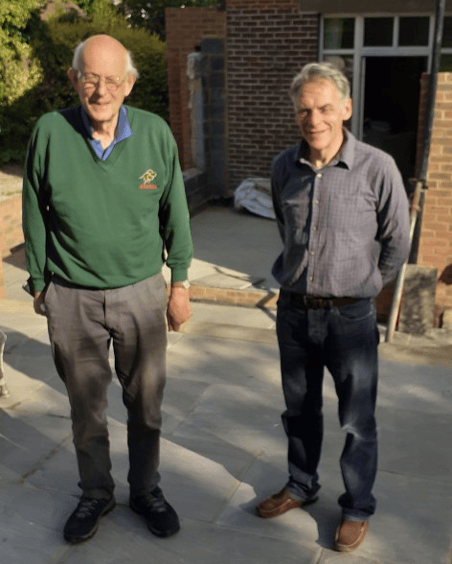
Richard is a font of knowledge on flora and fauna, local history and religion. During the hour of the walk that he joined me for, we discussed everything from hunting to the mistranslation of the Greek word metanoia as ‘repentance’ rather than ‘adopting a new mindset’ in the authorised King James translation of the Bible, as well as the defeat of the Cornish rebellion in 1497 on the ridge above Guildford. Sadly, as we entered Guildford Richard had to leave me and head back home.
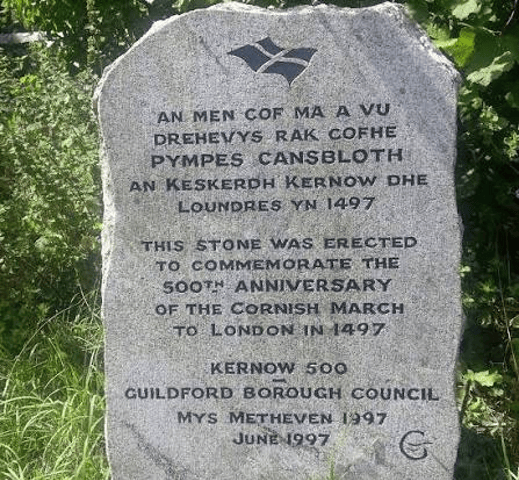
In a corner of The Mount, which overlooks Guildford, I passed a memorial stone which commemorates the Cornish rebellion of 1497 which I had chatted about earlier with Richard.
Guildford isn’t the most obvious place you’d expect to find a memorial to a 15th century Cornish rebellion. In general, the town has had a blessedly peaceful history. It has the good fortune to be situated in a long-settled part of England and shelters behind the joint protection of London and the Southern Coastal defences. Aside from the massacre of Alfred Atheling’s followers in 1036 and the far from spectacular capture of Guildford Castle by forces supporting the Dauphin of France in 1216, Surrey’s county town has been a comparative stranger to strife and bloodshed (if one also discounts the 19th century Guy riots and the modern-day lager-riots). And yet nearly 500 years ago, in an almost forgotten episode in the town’s history, Guildford was occupied by an army of perhaps as many as 15,000 insurgents from Cornwall, en route to an attack on the capital. The authorities in London, shaken at the arrival of such a force and far from confident of success, sent out an advance party to engage the rebels. The two sides clashed just outside Guildford and the town thus saw its first military action since high medieval times. Thankfully, despite subsequent Civil and World Wars, it has remained undisturbed ever since. However, the origins of this last, mini ‘Battle of Guildford’ lie a long way from the town or even Surrey itself.
In 1497, Cornwall was an isolated peninsula and a relatively independent part of England. It was primarily a Celtic land and retained its own culture and language. Prior to the ‘discovery’ of America, a man looking west from Cornwall would envisage only the immense ocean, extending without limit. Cornwall was on the edge of the known world.
This isolation had led to the Cornish keeping largely to themselves, largely removed from the hurly burly of English political life but all of that changed in 1485, with the victory of the Welshman Henry Tudor at the Battle of Bosworth. Members of the Celtic nobility, including the Cornish, who had aided his victory, were encouraged into the mainstream life of the nation.
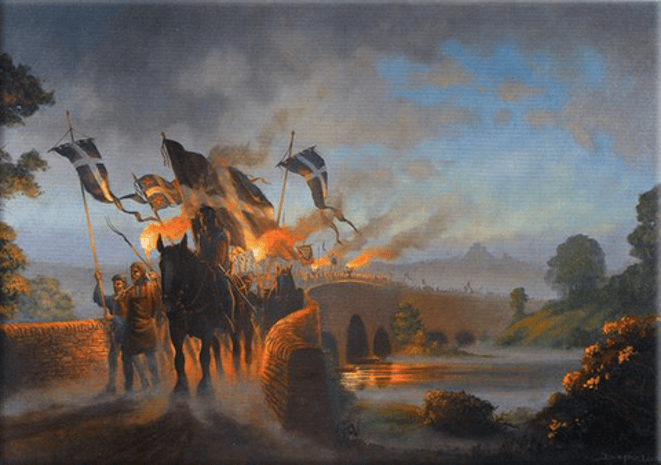
Henry, now Henry VII, rewarded his followers with titles and patronage. An unprecedented Welsh and Cornish presence developed at court. Celtic poets speculated about whether their race’s long subjugation was coming to an end.
The primary cause of the 1485 rebellion was heavy taxation, levied to fund a war against the Scots. The Cornish could not see that this was any concern of theirs. The bulk of Cornish society felt that the Scots were a matter for the English alone – and the northern English at that. Local community leaders emerged to voice their opposition to the heavy taxation. One of them was Joseph Smith (known as An Gof = the Smith), a blacksmith from St Keverne, on the Lizard peninsula in the extreme west of Cornwall.
It seems that the idea of a march on London was An Gof ‘s idea, conceived whilst leading a march of protesters to Bodmin in May 1497. There he encountered one Thomas Flamank, a Bodmin lawyer (and son of one of the principal tax-gatherers), who argued that such taxation was unlawful and that responsibility for it – and thus their grievance – lay with the most intimate of the King’s councillors, Cardinal Morton and Sir Reginald Bray, rather than the King himself. He further proposed that no harm was intended to any man by their actions and so, in the words of one chronicler (Francis Bacon) somehow persuaded the Cornishmen that: ‘he could tell how to make rebellion and never break the peace.’
Henry VII took a very different view. Armed with righteous indignation and ‘bows and arrows and bills and such other weapons of rude and country people’, an army of perhaps 15,000 Cornishmen marched into Devon, attracting considerable support in terms of provisions and recruits as they went. Aside from one isolated incident at Taunton, where a tax commissioner was murdered, their march was ‘without any slaughter, violence or spoil of the country’ – a fact that gives some credence to their initial, limited aims.
From Taunton, they moved on to Wells, where they were joined by their most eminent recruit, James Touchet, the seventh Baron Audley, a member of the old nobility and an accomplished soldier. Known to be a malcontent, dissatisfied with the recognition afforded him by Henry VII, Touchet must nevertheless have been singularly reckless to throw in his lot with such a desperate venture. Despite this prestigious additional support, ‘An Gof’, the humble blacksmith remained in command of the army. Audley joined Flamank as joint ‘political’ leader of the expedition.
By Tuesday 13th June 1497 the Cornish army arrived at Guildford and the following day skirmished at Gill Down with 500 spearmen that had been despatched by Henry VII. After this initial military encounter, the rebellion moved to a swift conclusion. The Cornish army left Guildford and moved to Blackheath where they pitched their final camp, looking down from the hill onto the Thames and City of London. On Saturday the 17th of June the Cornish army of between 9-10,000 rebels were roundly beaten an army of 25,000 royal troops. Without mounted cavalry or artillery arms the rebels stood little chance. Between 200-2,000 Cornishmen were killed. Their leader, ‘An Gof’, was dragged to Tyburn on a hurdle on Tuesday 27th June and there hung drawn and quartered. He met his end with characteristic bravery, defiantly exclaiming, ‘He should have a name perpetual and a fame permanent and immortal’
I suspect that Richard’s departure was cunningly designed to avoid gut busting hill climbs, the first of which involved the ascent of Saint Martha’s Hill, also known as Martyr’s Hill after Thomas Becket. The hill rises 570 feet and gives a wonderful panoramic view over 7 counties.
John Bunyan, the author of Pilgrim’s Progress, who lived in Guildford, is said to have derived the idea of “The Hill of Difficulty” from the path leading from nearby Chilworth Manor to Saint Martha’s Church. Having slogged up it, I can see how he got his inspiration!

One of the features of this section of the Pilgrims’ Way is the extremely sandy soil – at times it almost felt as though I was walking through sand dunes and around the next corner the sea would appear!
I made good progress along the greensand ridge outside Guildford and descended into the picture postcard village of Shere, long thought of as one of the prettiest villages in England.

I couldn’t linger long in the village as I had a midday lunch appointment with old friends James and Sarah at Netley House, an imposing National Trust house, just outside Gomshall, which is visible from miles away. In the thirteenth century the Saxon manor of Gumesele was granted to the Cistercian Abbey of Netley near Southampton, but the present house was built around 1780 and subsequently rebuilt after a devastating fire destroyed much of the house in 1860.

It was great to catch up with James and his wife Sarah and reminisce about our time together at Oxford and chart the progress of our lives over the last 40 years. James has run a successful business from Netley House and specialises in the conservation and restoration of historic buildings.
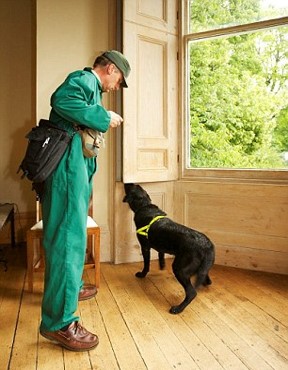
I have always been intrigued by the ‘rot hounds’ that James uses to detect rot in historic buildings and was interested to read an article about them in the national press which appeared a few years ago, the content of which is appended below.
Two ‘useless’ dogs who were abandoned by their owners are now saving some of Britain’s most historic homes after being hired by the National Trust to sniff out dry rot.
Labradors Sam and Wilson have been specially trained to alert surveyors to damage which is invisible to the human eye in stately homes.
The so-called ‘rot hounds’ have already saved conservationists hundreds of thousands of pounds by leading them to the early signs of dry rot at National Trust properties.
The labradors are the only two professional dry rot sniffers in Britain and happily carry out their work in return for chocolate rewards
James’s wife Sarah is a priest who is active in the Surrey Hills district and regaled us over lunch with a number of interesting anecdotes including be8ng lead down the labyrinthine coridoors of the Vatican by Swiss Guards for a private an audience with the Pope! If I make it to Rome, I’ll hopefully be picking up my Pilgrim’s certificate from the Vatican!
After a delicious lunch, James bade me farewell and showed me a short cut from the back of his house up a path to rejoin the Pilgrims’ Way.
I was back on familiar territory, having spent much of my childhood living not far away near the small village of Headley, nestled on the North Downs near Box Hill.
I passed the pilgrim church on Ranmore Common (sadly closed to visitors) and descended through Denbies vineyard towards West Humble. Denbies is one of the largest vineyards in England and is situated on a spot where grapes have been grown since Roman times.

‘Surrey Gold’is one of their most popular wines made with a blend of Muller-Thurgau and Reichensteiner grapes and particularly good with cheese and spicy Asian dishes!
Denbies benefits from a geography that is very similar to the Champagne district of France. And as such, much of their production is a sparkling wine produced using the same method as champagne (which curiously enough was a technique invented in the UK).
From a good harvest, Denbies can produce up to 400,000 bottles of wine, about 10% of all the wine produced in the UK and they have around 20 grape varieties, including the Pinot Noir and Chardonnay grapes necessary for producing a champagne type sparkling wine.
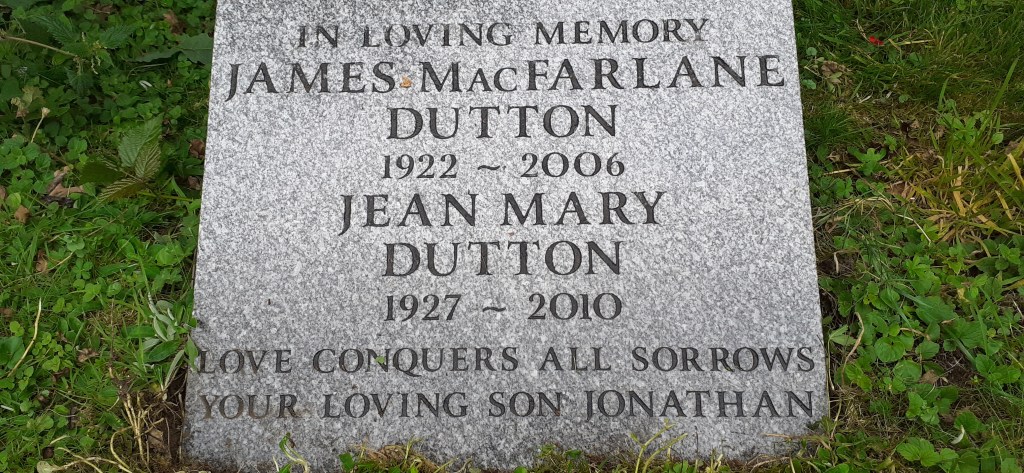
An acquaintance called Mark had kindly offered to put me up for the night at his home in Dorking. After meeting up with him, he gave me a lift to Headley which allowed me to visit my parents’ memorial in the churchyard of St Mary’s. It was the first time since their memorial service ten years ago that I had visited the graveyard. It was a family tradition to walk up to the Cock Inn at Headley for lunch each Boxing Day. The pub was my father’s local. As for St Mary’s church, I don’t remember by parents ever darkening its portals. I don’t think my mother ever walked more than five miles in her life. I’m not sure what she would have made of my walk to Rome!

As I stood in front of the memorial to my parents, for some reason the words of Under Ben Bulben by William Butler Yeats came to mind:
Under bare Ben Bulben’s head In Drumcliff churchyard Yeats is laid, An ancestor was rector there Long years ago; a church stands near, By the road an ancient Cross No marble, no conventional phrase, On limestone quarried near the spot By his command these words are cut: Cast a cold eye On life, on death. Horseman, pass by!


Leave a Reply