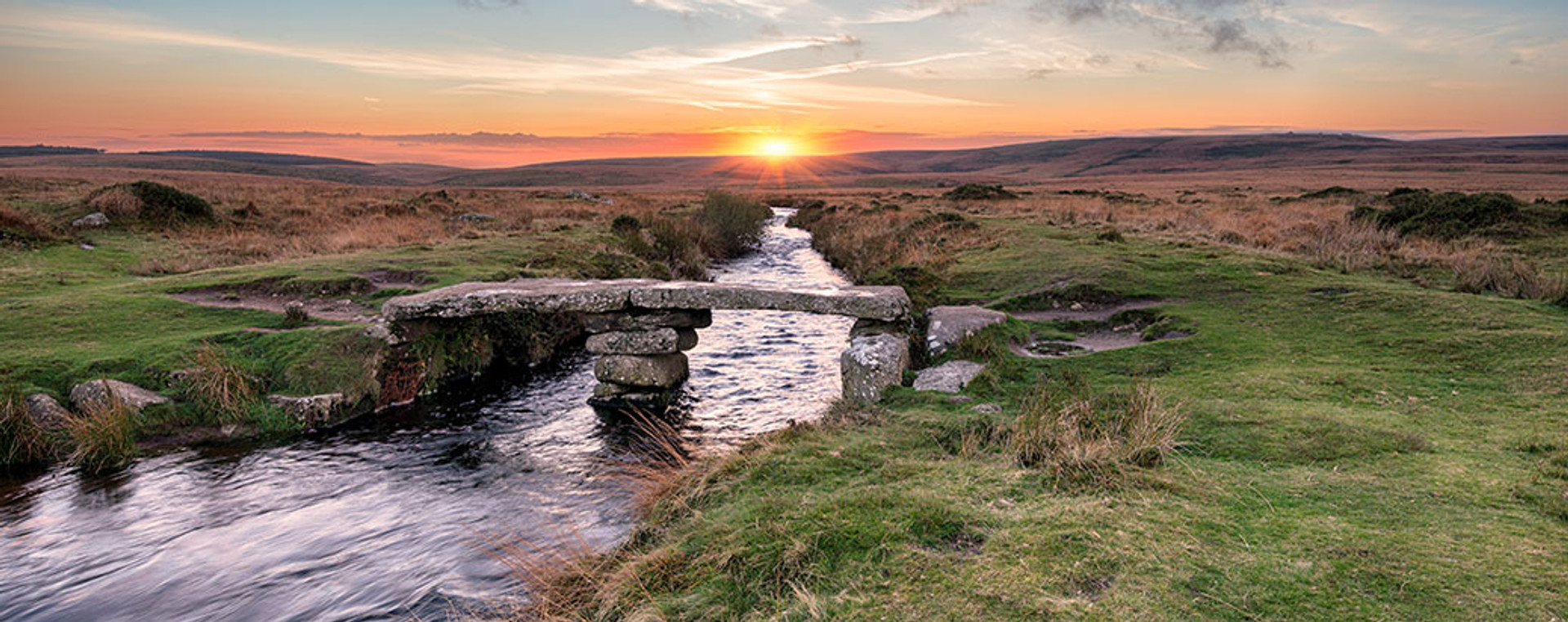
La France, c’est l’Aveyron avec quelque chose autour
Aveyron Proverb
Walking the best part of 30 miles in 10 hours, attending pre-prandial vespers at a praemonstrian abbey, sharing a 2 hour meal with 10 french people you’ve never met before and then attempting to write an amusing and informative blog of the day’s activities while ensconsced on the top bunk of a dormitory full of snoring pilgrims isn’t a recipe for fluent prose and witty anecdotes – but here goes anyway!

The previous evening at the Gite Halte St Jacques had been a convivial all male occasion. The excellent soup and pasta ( which I managed second helpings of) hsd been accompanied by some local vino.
Before supper I had got chatting to Jean-Marc who had been bemoaning the state of the French medical system. His wife had died of cancer which had been completely midiagnosed whilst he was going to have to wait 6 months to see an optician and get his specs changed!
Sebastian, the bearded chap with glasses kindly helped me to second helpings of soup and pasta. He looked in his mid 2ps but was in fact in his mid 40s. He lived in the Correze. It was his first pilgrimmage. He was an ex military musician who now helped handicapped children with musical psychotherapy. His specialisation was metal balls which he used to place on people with mental problems and women who were pregnant to alleviate tension. Apparently his techniques worked wonders.
I left the gite in Espalion at 6.20am only to realise that French bakeries don’t open until 7am! After 40 minutes of bimbling around, I eventually got my 2 pain au chocolats and headed out of Espalion.
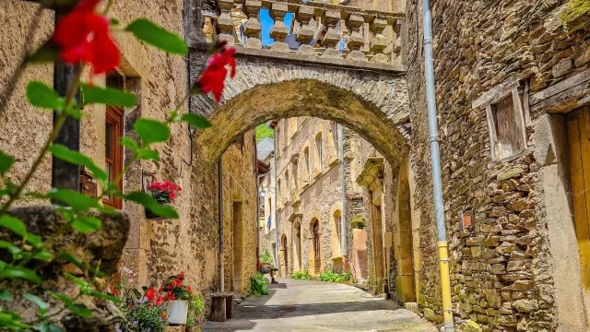
With its narrow medieval streets, houses which exuded affluence cloaked in a web of climbing roses a fairy tale castle which dominated the horizon and overlooked the river Lot, Estaing was every inch worth it’s designation as one of the prettiest towns on the Chemin de St Jacques. There were pilgrims aplenty in the high street including one who was in the process of being unceremoniously evicted from a café for having had the temerity to have sat down at a table and eaten his lunch which he’d bought elsewhere! Ex French President Valéry Giscard d’Estaing bought the chateau in 2005 but although he lived to a ripe old age, dying aged 94 in 2020 he never actually lived in the chateau!
Thankfully it wasn’t raining as I headed along the banks of the River Lot towards Golinhac.
I’d hoped to get to Golinhac by 12.30am. My guidebook suggested it had a village shop. Having turned on tbe afterburners, I managed by tge skin of my teeth to get to the village shop by 12.29am. Imagine my disappointment when I read the sign in the window that the shop was exceptionally closed today from 12am! From the long line of people dressed in black trooping through the village, it seemed that a funeral had just taken place and that this might be the reason for the ‘fermeture exceptionelle’ of the village shop.
Disappointed, I headed off towards Espéyrac, which apparently had a shop which served food. All being well, I would arrive there around 2.30pm and able to appease my rumbling tummy.

When I arrived bang on schedule at 2.30pm, there were a couple of other pilgrims hovering outside the village shop in Espéyrac which offered all sorts of goodies ranging from sandwiches to tempting looking ice lollies. When I looked at the sigb on the door, I couldn’y quite believe my eyes – shop closed from 1.30-3.30pm! It obviously wasn’t my day. I headed off towards Conques, swearing quietly to myself about the vagaries of French opening hours!

In France Aveyron is synonymous with La France Profonde. It’s one of the largest departments in France as well as being one of the least populated where cows outnumber people by 50%. Aveyron is also a region of villages – it has more official Les Plus Beaux Villages than any other region! Emblematic of the Aveyron region is the story of Viktor the archetypal ‘wild child’, who was found living in isolation in the forests of the Aveyron in the 18th century. In the late 1790s, a young boy aged around nine or ten was seen roaming around in the Northern Tarn, apparently living wild. He was captured on several occasions but managed to escape each time.
At some point in early 1800, he crossed over the border into Aveyron, where three men captured him again. At that point, he was dishevelled and almost naked. He escaped yet again and finally turned up in a dyer’s house in Saint-Sernin-sur-Rance. This time, he was sent to an orphanage in Saint-Affrique and then to one in Rodez. Thus began one of the most celebrated and documented cases of a child living alone in the wild. After his capture, all kinds of rumours about the boy and his possible origins began to fly around. His behaviour, jerky movements and lack of speech led people to believe that he had lived in the wild from a young age. They speculated that scars on his body were evidence of contact or struggles with animals.
Although he was clearly not deaf, the boy was sent to the National Institute of the Deaf in Paris. There, he became an object of study to determine what differentiates humans from animals. Since language was considered to be the main distinguishing factor, Victor became a case study in speech education. However, he made little progress, and the specialists gave up on him.
Eventually, the case came to the attention of a physician, Jean Marc Gaspard Itard, who specialised in educating deaf people. He took Victor (it was Itard who named him) into his house and attempted to socialise him and to teach him to speak. These efforts were largely unsuccessful, and Itard considered this one of the failures of his career. The boy seemed to be impervious to learning more than the simplest life lessons. Although he made some slight progress over five years or so, he learned to speak or read only a handful of basic words.
Although Itard concluded that Victor might have lived in the wild for as long as seven years and may have lost much of his early education, he found that the boy was not entirely without social skills. One day he gave him some raw potatoes one day, which Victor immediately put into the open fire, showing that he understood the concept of cooking.
For Victor, the call of the wild remained strong. He could spend hours looking out of the window and loved the snow. Itard took him on a two-day visit to a wooded valley just outside Paris, but the boy was agitated and attempted to escape continually, so Itard decided to discontinue these outings. Instead, he and Mme Guérin took Victor to parks and gardens in Paris. Itard’s experiment eventually came to an unsuccessful end. Victor remained living with Mme Guérin, who received an annual sum for his care, from 1811 until his death from pneumonia in 1828
On the vertiginous descent into Conques (which I remembered in 1989!) I met a couple of pilgrims gingerly descending. One of them looked at me and exclaimed ‘I think you are crazy!’ as he looked at my hat. Taken aback I smiled sweetly, slightly bemused. Then the penny dropped – what he had said was that there is a spider on your hat but it is dead now. I thought he’d said ‘ vous avez les araignées dans la tête’ which means in French, you are bonkers!
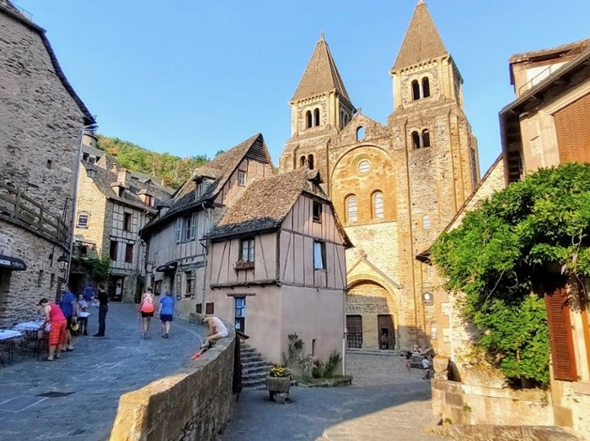
I arrived in Conques bang on 5pm, having walked 30 miles in 10 hours. Quietly chuffed I took a quick look around the magnificent Abbey Church of Le Foy (about which more tomorrow) and checked into the Abbey hostelry for the night.
It had been a long day and after supper with 90 other pilgrims in the refectory, I conked for the night!
.


Leave a Reply