Faber est quisque fortunae suae
Appius Claudius Caecus
A day which began well nearly ended in disaster 12 hours later, the unlikely person who saved the day, being the proprietor of a Renault repair shop.
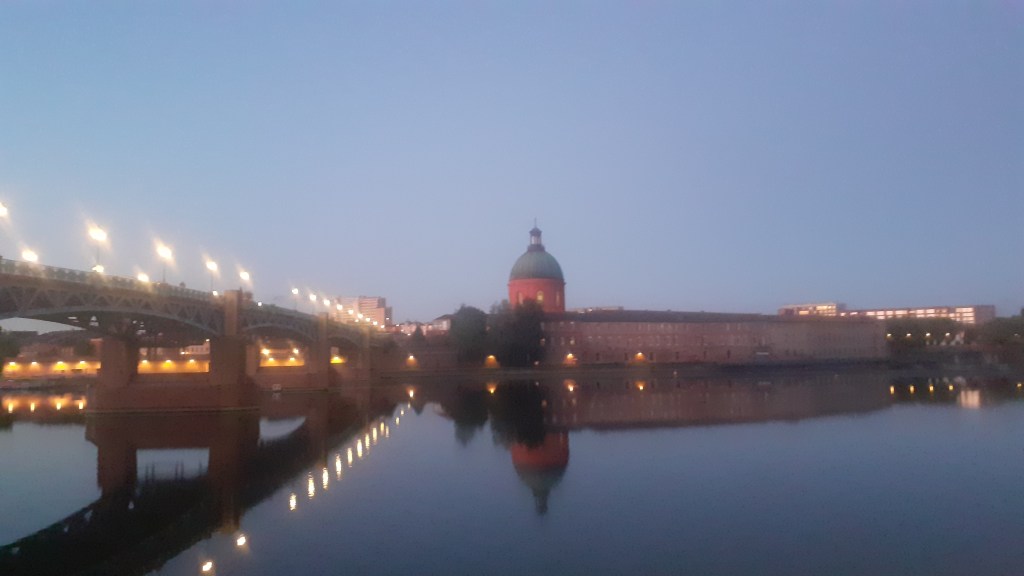
I set off from my hotel in the centre of Toulouse with the sun yet to rise and made my way along the Canal du Midi and then the banks of the Garonne towards Blagnac, the aerospace hub.
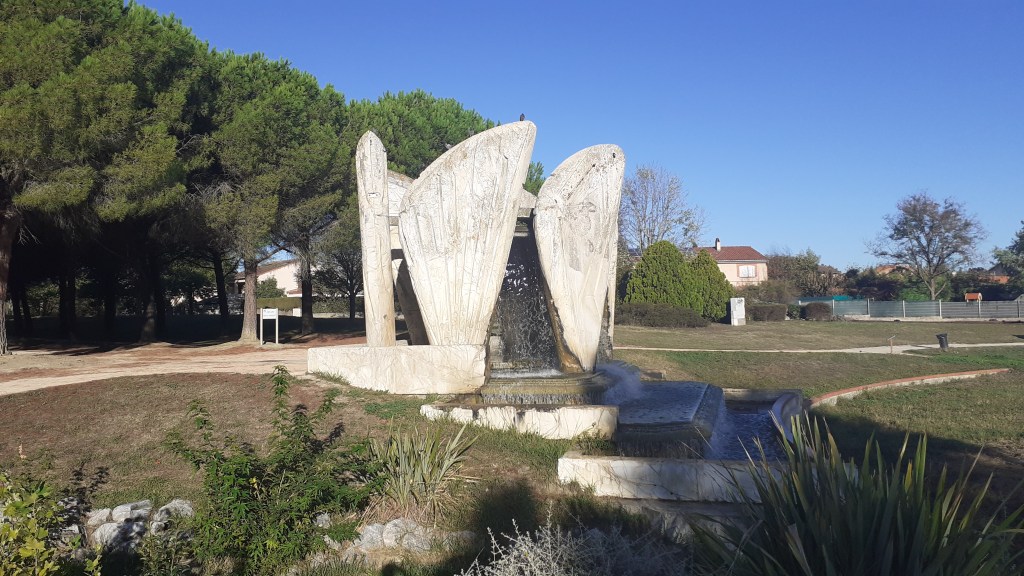

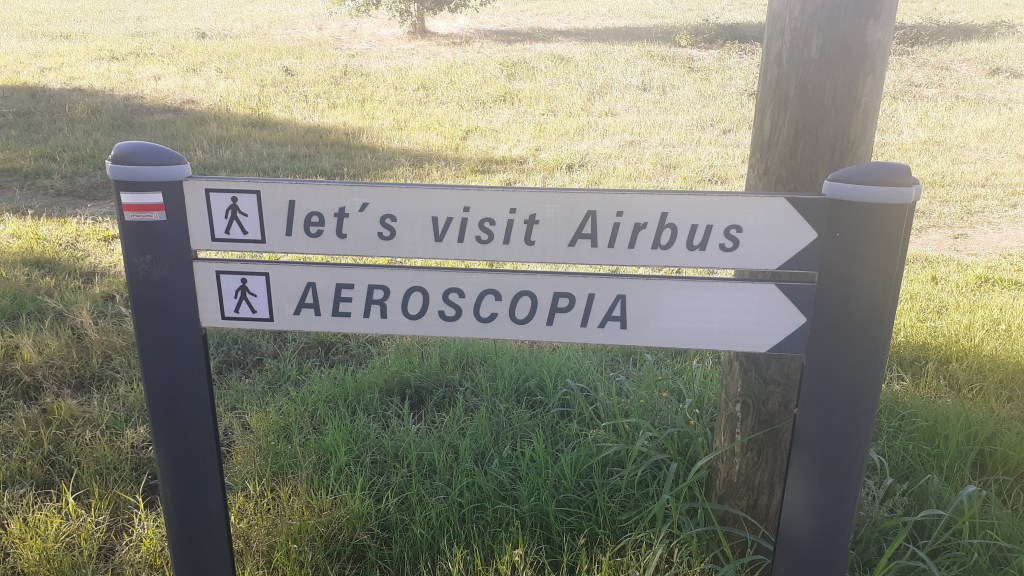
It did feel a trifle bizarre to be pounding the tarmac near Toulouse airport and the hub for Airbus. This was a place I have visited regularly over the last 12 months but always by car and never on foot.
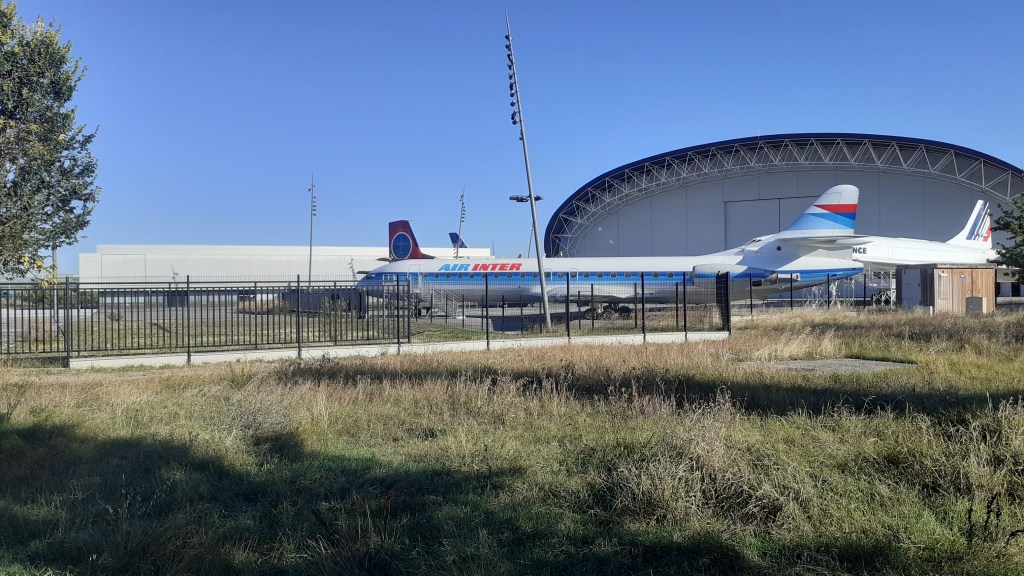
Whereas the approach to Toulouse from the eastthe previous day had been through pleasant rural landscape, today was quite the reverse – hours if tarmac pounding through the suburbs of Toulouse. And I had another challenge on my hands – the battery on my phone was down to 50% and that would have to last me the whole day, so there was no room for mistakes….

At midday I reached Pibrac, a pretty hilltop town with an impressive church. My GPS suggested it was the correct route but when I arrived in the historic centre of town there wete no red and white signs indicating I was still on the GR653! As I wandered around the centre of town an old lady opened a window and asked if I was lost. She was working in parish office and offered to stsmp my passport before sending me on my way back down the hill to rejoin the Chemin d’Arles (GR653)
Before I left Pibrac I had a quick look around the Basilica of Sainte Germaine. Started in 1901, the current basilica was finished in 1967. It is commemorated to Pibrac’s very own saint- Germaine. Born in 1579, Germaine died in poverty 21 years later in 1601. Even by the standards of the time her life appears to have been pretty miserable.
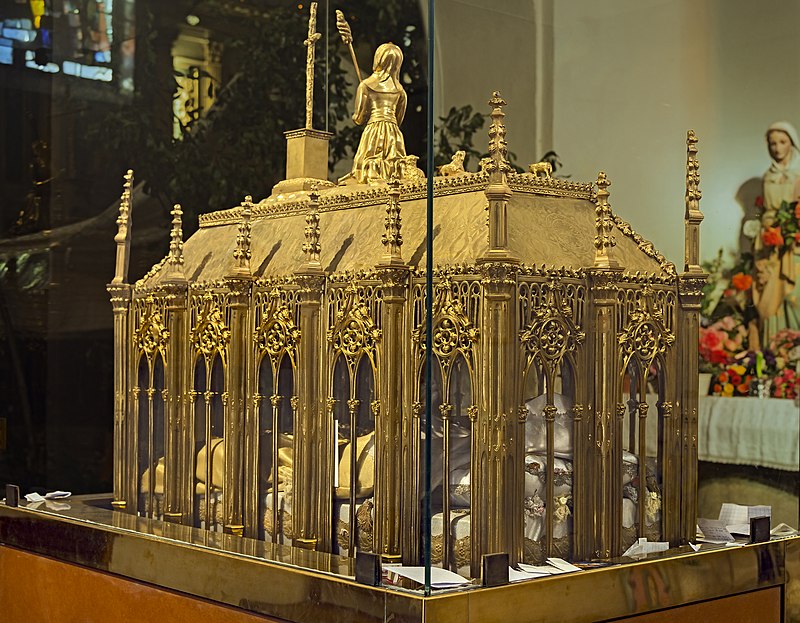
Germaine suffered from scrofula , had an atrophied hand and her mother died when she was very young. Her father remarried a cantankerous woman and Germaine was relegated to live in a shed.
She persuaded her father to send her to tend the flock of sheep in the wild, where she could say her rosary and find comfort in prayer. She went to mass every day, and gave the little bread she had to the poor.
One day in 1601, her father found her dead in the cubbyhole where she was forced to sleep. She was 22 years old. She was buried in the church of Pibeac , and pretty soon everybody had forgotten about her. That is until the miracles started.
On the night of her death, it is said that two monks on their way to Pibrac at nightfall saw two young girls dressed in white passing towards the house of her father, Laurent Cousin. The next morning, as they resumed their journey, they saw three young girls come out, one of whom, framed by the two others, was crowned with flowers.
After her death, a couple of miracles occurred.
In 1644, while the sexton was preparing to hold a funeral by digging a grave, he came across a buried body whose freshness amazed him. Even the flowers the dead woman was holding had barely wilted. Germaine Cousin was recognized by the deformity of her hand and the scars of the lymph nodes in her neck. Her body was placed in a lead coffin, offered by a parishioner healed through the intercession of the saint, and placed in the sacristy where she remained, forgotten for another sixteen years.
Then in September 1661, Jean Dufour, a local ecclesiastical dignitary came to visit Pibrac. He was surprised to see Germaine’s coffin in the sacristy, had it opened, and discovered that the saint still presented the same state of freshness as the day she died in contrast to bodies in nearby graves which were just skeletons. The process of canonising Germaine was initiated in 1700 and 167 years later in 1867 she was canonised.
I grabbed a sandwich at a bakery in Léguevin. The baker’s aged Alsation was slumped inside sheltering from the heat. As I sat outside consuming my baguette, a steady stream of locals entered the bakery, greeted the aged retainer, and went their way with a baguette or a vienoisserrie in their shopping basket. Health and safety eat your heart out!
Most of the afternoon was spent slogging through a forest, grateful for my GPS which helped me navigate through the largely unmarked trails. The downside was that the GPS feed was draining my already depleted battery. By the time I reached L’Isle Jourdain, I only had 3% battery left.
As I rang my hosts for the evening my phone battery expired. Ah well, I thought to myself, no worries – in 20 mins I’ll be luxuriating in a hot bath after pounding the tarmac for 40km in 10 hours.
Some 2 hours later I was still walking up the side of a busy highway being periodically hooted by HGVs speeding past at breakneck speed, none the wiser as to where the turning down to their house was. Time to throw in the towel, I thought to myself, and camp out in the next field?
A Renault garage loomed into view on the side of the road. It was nearly 7pm – they might still be open and I might be able to replenish my empty water bottles before pitching my tent for the night.
As I was unpacking my backpack in the vain hope that there might be sufficient juice in one of my battery packs that I could recharge my phone and call them to tell them that I was at a Renault garage near where they lived, the proprietor of the garage ( who lived in the adjacent house) appeared. I explained my predicament (lost, knackered, out of battery and out of water with no clear way of getting to my hosts for the evening!)
Charm personified, Monsieur Ortolan proceeded to fill my water bottles from his garden tap, recharge my phone, inquire who my English friends were and where they lived, divulge that he had been born in this precise location 65 years ago and then offered to give me a lift to my hosts’ house just down the hill. 10 minutes later and I was safely esconced with my hosts for the evening, luxuriating in a warm bath and thanking my lucky stars that I had chanced on the man (Monsieur Montolan) from the Renault garage. Fortune favours the brave!

 Pilgrim's Progress - Long Distance Walks in Europe and the UK
Leave a reply to Richard Willaim D’Oyly Hemingway Cancel reply