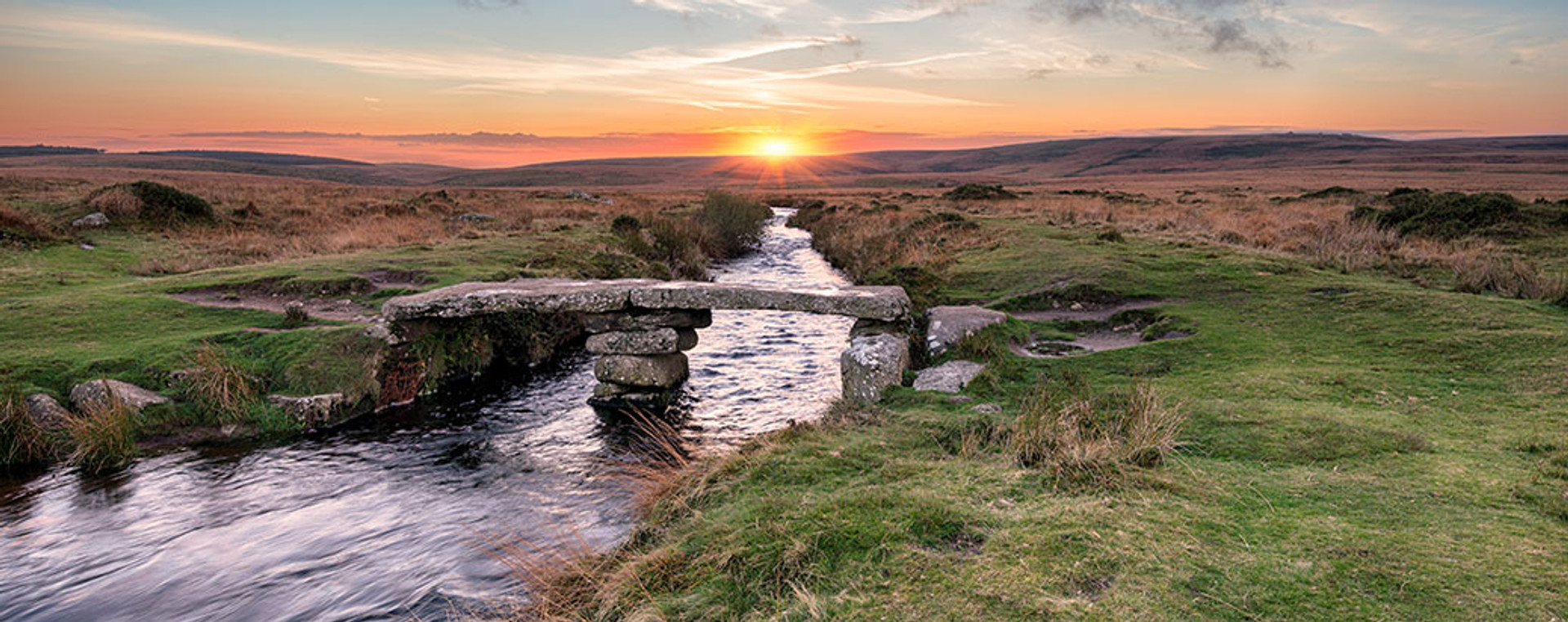
Gilded and green of hue, of subtle charm,
Dark poison of the soul,
She glides into the glass, and steals the calm
From out the quiet bowl.
Arthur Symons – The Absinth Drinker
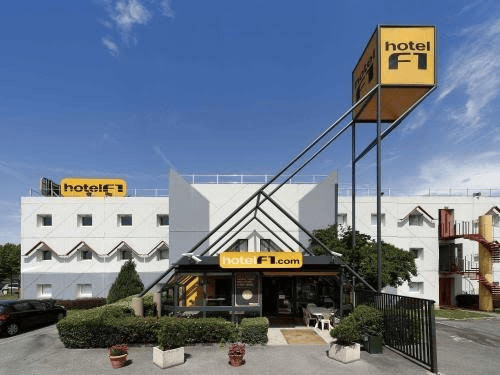
The Hotel F1 partially redeemed itself overnight. It was clean, I enjoyed a good night’s rest, and the buffet breakfast was more than ample for my needs! With the benefit of hindsight, my goal of walking nearly 40km from Pontarlier to Orbe was a tad ambitious! On paper 40km looked perfectly achievable with an early start. In practice, however, by mid-morning it had become apparent that the thought of reaching Orbe in a day was something of a pipe dream.
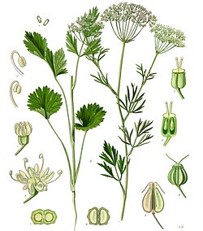
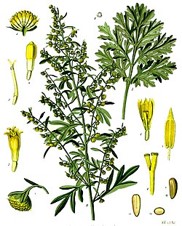
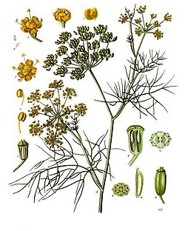
Pontarlier is primarily famous for one thing – Absinthe! Absinthe as we know it today, originated in the Swiss town of Couvet in 1789 by Dr. Pierre Ordinaire. Dr. Ordinaire, originally from the Franche-Comté region of France, went into self-exile after the French revolution due to political reasons. While traveling through the Val-de-Travers in Switzerland, the doctor allegedly found the plant grande wormwood (Artemisia absinthium). He began to combine this plant with other herbs and alcohol and began to distil the concoction. The distillate soon became well known in the region as a cure-all and for its unbelievable healing powers. Because of its greenish tint, it became known as La Fée Verte (The Green Fairy).
It wasn’t long until absinthe began to catch on across the Doubs River in France. One problem the company soon faced was the high taxes on liquor imported into France. The solution was to build another factory across the river in the small sleepy town of Pontarlier. So, in 1805, a new, larger factory was formed under the name, Maison Pernod Fils. Pontarlier was the perfect solution, as it was not only located on a major waterway, and had access to the French railway network. When the factory opened it produced approximately 16 litres of absinthe a day.
As absinthe gained in popularity, Pernod purchased a second, larger factory and began to produce more than 400 litres a day. By the middle of the 1850s, production had grown to over 20,000 litres a day and at the height of their production, over 30,000 litres a day. The name Pernod Fils became synonymous with quality absinthe. They set the bar high in quality and innovation, and every absinthe company tried to imitate them. By the end of the 1800s, 14 distilleries had sprung up in Pontarlier alone.
Another way that absinthe was gaining strength in popularity was from the vine eating insect, grape phylloxera. This insect single-handedly destroyed two-thirds of the vineyards on the continent of Europe. The wine industry was decimated. This insect, which feeds on grape roots, either stunts the growth of the vines or kills them, thus limiting the availability of wine. With the growing production of absinthe and the lack of availability of wine, absinthe soon became the most popular alcoholic drink in France. In the late 1800s France was drinking more absinthe than all other countries combined. It was said that due to the incredible amounts of absinthe being consumed in the evenings, the smell of anise filled the air of the streets of Paris.
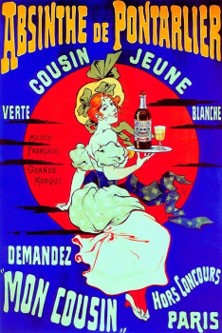
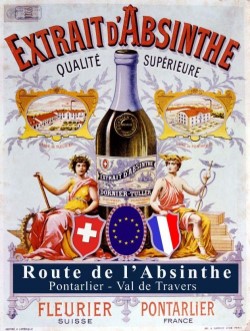
By the end of the 19th century, absinthe was the favoured cocktail of Paris, and crowds would gather at 5pm to imbibe in neighbourhood bars and bistros. This time soon became known as the ‘green hour,’ or L’Heure Verte. Absinthe had developed into a very sociable drink and is said to be the first crossover drink where ladies were allowed to drink in the company of gentlemen. It was also thought to help women with their monthly issues.
It was bitterly cold as I left Pontarlier in the early morning half-light. Overnight there had been a sharp frost and leaves were falling from the trees as I made my way out of town towards La Cluse-et-Mijoux.

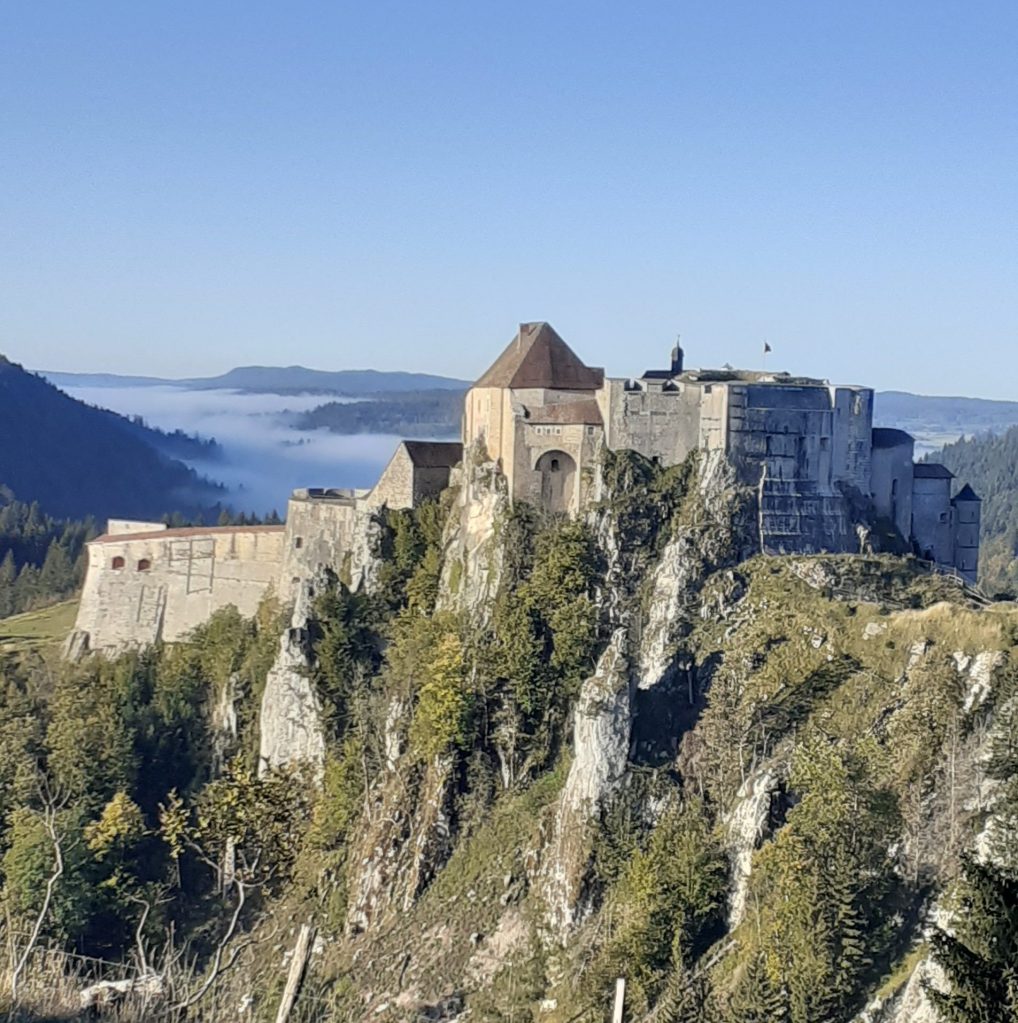
After an hour’s climb through thick woods, I emerged on the side of a valley overlooking the most magnificent fairy tale castle imaginable. Perched on top of a massive rocky outcrop, it looked utterly impregnable. Built in the 11th century it was owned by the dukes of Burgundy before being transformed into a prison after the Napoleonic wars, housing a number of famous individuals including Mirabeau, Heinrich von Kleist and the leader of the Haitian Revolution, Toussaint Louverture, who died there on 7 April 1803. It was a long way from the coasts of Haiti!
A couple of photographers in camouflage gear were busy photographing a chamois which was grazing in a clearing in the woods.
I’ve never seen a chamois in the flesh before so this (along with numerous red squirrel sightings) was a first for me. Of course seeing a chamois was a reminder that I was approaching the Pyrenees as the chamois native to this region as well as the mountains of south and central Europe, Turkey, and the Caucasus. Chamous live in precipitous, rugged, rocky terrain at elevations of up to 3,600 m (11,800 ft). In Europe, the chamois spends the summer months in alpine meadowland above the tree line, but move to elevations of around 800 m (2,600 ft) to spend the winter in pine forests.
During mid morning I got lost in thick woodland en route to Les Fourgs. Thankfully I was able to get a GPS bearing on my Via Francigena App and navigate my way for a couple of kilometres through thick undergrowth back onto the correct path. It was quite knackering and it must have cost me at least half an hour, time which I could ill afford if I was to reach Orbe by nightfall.
There has been a disappointing lack of food shops in many of the small villages I have passed through over the last 6 weeks. But Les Fourgs turned up trumps just when I needed it! Not only was there a small food store in the village, but the lady behind the counter also kindly stamped my pilgrim passport as I paid for my cold chicken breasts and apple.
For most of my walk along the Via Francigena, navigating the correct route hasn’t been a huge problem. The combination of guidebook, hard copy maps, GPS App and compass, has usually enabled me to find my way. After lunch, however, everything went pear shaped!
Following a sign marked Via Francigena to Les Hôpitaux-Neufs (10 km) I passed a chapel that had been erected by the villagers of Les Fourgs in thanks for not having been occupied by the Germans during the last war. A quick glance at my map and compass, suggested I was heading in the right (due south) direction.

I followed the way post sign up a well marked farm track but 15 minutes later the signs had petered out and the track was blocked with wire netting. When I checked my Via Francigena App, it indicated that I should have turned right in Les Fourgs and followed a tarmac road towards Jougne. Grinding my teeth in frustration I retraced my steps back to Les Fourgs, passing a number of Via Francigena signs as I did! I had gone around in a complete circle and wasted almost an hour.
It was palpably obvious by this point that I wasn’t going to reach Orbe by nightfall! But the sun was shining and, with the pressure off, I was able to relax and gently make my way to Jougne. I hadn’t actually booked any accommodation for the evening, but I was reasonably optimistic that something would turn up. And if it didn’t, well I could possibly sleep in the church in Jougne or, at a pinch, in my tent and one season sleeping bag!
When I reached Jougne it was still only 3.30pm. The Mayor’s Office was closed until 4pm and the Hotel Poste, which somebody had recommended, was closed until 5pm.
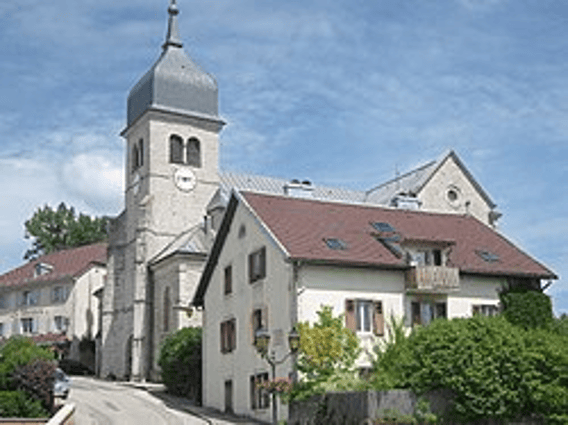
Jougne isn’t exactly blessed with a vast array of things to see and do! Apart from visiting the church, other options appeared limited to non existent. So enter the church I did and spent a pleasant hour there enjoying the serenity.
I am staying the night in Jougne with Mireille Godart at ‘Le Castelou’ gite D’Etape. With the entire downstairs apartment of her house at my disposal for the night, this marked a significant upgrade from the Hotel F1 in Pontarlier!
Mireille Godart has a heart of gold. After warmly welcoming me to her gite, she fussed around in my bedroom, ensuring that the sheep skin blankets on my bed were safely tucked in with ‘hospital corners’. She then announced that she was leaving me with a jar of her home made rhubarb jam for my breakfast, to ensure I wouldn’t starve to death during my 19km walk to Orbe tomorrow. The piece de resistance, however, was when she appeared before I had started eating my supper, with a bowl of delicious soup she had specially prepared for me!
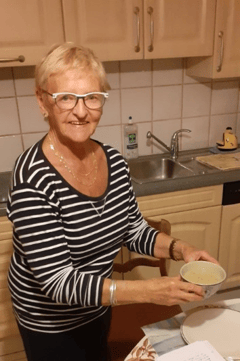
It is constantly humbling to be welcomed into the houses of hosts who provide such a generous welcome to pilgrims such as myself. They epitomise the best of the human spirit and meeting them on the Via Francigena has been a hugely humbling and uplifting experience.
In some ways it had been a bit of a frustrating day, at times it felt as though I had been chasing my tail around in circles. But at the end of the day, I’d been grateful for the opportunity to take my foot off the gas and arrive in Jougne at a sensible time of day.
As for tomorrow, who knows what surprises lie in store for me. But one thing is for sure, I couldn’t have wished for better accommodation than chez Mme Godart in Jougne. ‘Every Cloud has a Silver Lining’ as the old saying goes!


Leave a Reply