It is only one step from fanaticism to barbarism
Denis Diderot
I spent last night in Langres having supper with my Belgian friend, Claude, at the Le Foy Restaurant in the centre of Langres, over looked by the imposing9 statue of Denis Diderot.

It felt slightly surreal to be sitting down with Claude in the Le Foy Restaurant that was a stone’s throw away from the Presbytery Hostel where Georges and Baptiste were spending the night. At the table next to us was a large group of raucous men and women who had just attended a wedding. Judging by the sound of their braying voices and the tone of their conversation it was clear that they were both English and extremely affluent. Mid way through supper they were joined by a large corpulent man who looked a bit like Marlon Brando in the Godfather, who approached our table and asked if he could take one of our chairs and join the table behind us. Claude explained that I was an Englishman who had walked to Langres all the way from Wiltshire. The man, who told us he was Italian, appeared confused and somewhat disbelieving.
“Are you a Catholic then, going to meet the Pope?” he enquired.”No”, I replied, “I’m Church of England and I’m walking to Rome to raise money to repair the roof of our church in a small village near Stonehenge”. He smiled at me as if I was deranged and had taken leave of my senses. “Then why don’t you drive to Rome?” he asked.”It is much quicker!” With that he turned on his heels and joined the wedding party behind us!
Slightly chastened by this experience, I returned to the large pizza with Langres cheese that I had been eating before the Italian had appeared. The pizza was utterly delicious even though I did feel slightly guilty at the thought of abandoning Georges and Baptiste over the street to their meagre pilgrim rations.
You can’t go very far in Langres without coming across Denis Diderot.
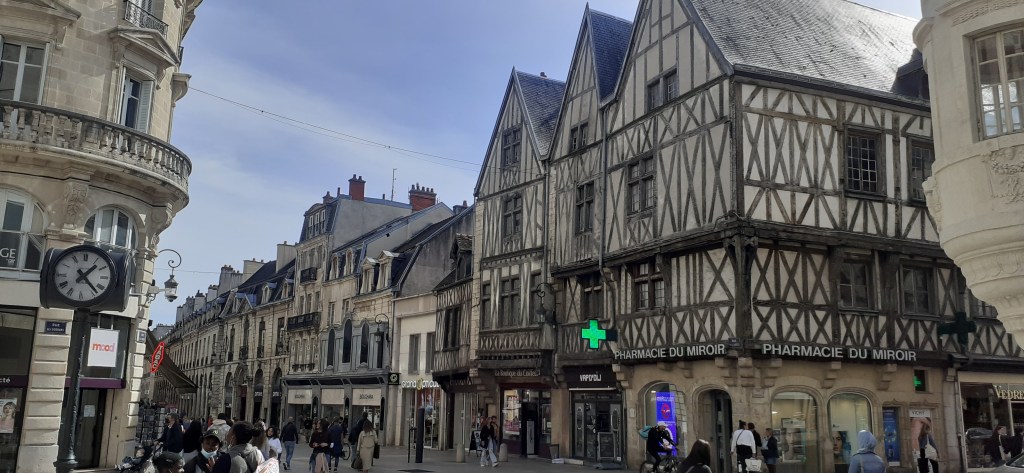
There is a Diderot bakery, pharmacy, high school, museum, bookstore, street and restaurant named after the philosopher and leading figure of The Enlightenment who was born in Langres in 1713. Apart from the fact that France’s longest river, the Seine, rises near Langres and Langres cheese is made in Langres, everything about the pretty town is dominated by the figure of Denis Diderot.
So who was Denis Diderot and why is he still such a big cheese in Langres?

It is probably no exaggeration to say that Denis Diderot was one of the most important 18th century French philosophers who sowed the intellectual seeds which ultimately germinated and helped precipitate the French Revolution in 1789. Diderot might not have created the phrase ‘Liberté, Égalité, Fraternité’ but his philosophical works, the most important of which was the ‘Encyclopédie’ provided the intellectual bedrock for the French Revolution and the overthrow of the Ancien Régime.
Denis Diderot was born on October 5, 1713 in Langres and died aged 70 on July 31, 1784 in Paris. A man of letters and a philosopher from 1745 to 1772 Diderot served as chief editor of the Encyclopédie, one of the principal works of the Age of Enlightenment.
Diderot was the son of a respected master cutler. He was tonsured in 1726, and though he never took holy orders, he was educated by the Jesuits in Langres.
From 1729 to 1732 he studied in Paris and was awarded a master of arts degree at the University of Paris in 1732. He then studied law for a while but was more interested in languages, literature, philosophy, and higher mathematics. Not much is known about his life from 1734 to 1744. He dropped an early ambition to enter the theatre and, instead, taught for a living, led a penurious existence as a publisher’s hack and wrote sermons for missionaries. At one time he seems to have even thought about taking holy orders.
He frequented coffee houses, and it was in one of them where he met the philosopher Jean-Jacques Rousseau in 1741 and established a friendship with him that was to last for 15 years,
In order to earn a living, Diderot undertook translation work and in 1745 published a free translation of the Inquiry Concerning Virtue by the 3rd Earl of Shaftesbury whose fame and influence he spread in France.

In 1745 Diderot was asked to bring out a French translation of Ephraim Chambers’ Cyclopaedia, after two other translators had withdrawn from the project. Diderot undertook the task with the distinguished mathematician Jean d’Alembert as coeditor but soon changed the scope of the publication, broadening its scope and turning it into an important organ of radical and revolutionary opinion. He gathered around him a team of litterateurs, scientists, and even priests.
All were fired with a common purpose: to further knowledge and, by so doing, strike a resounding blow against reactionary forces in church and state. As a dictionnaire raisonné (“rational dictionary”), the Encyclopédie was to bring out the essential principles and applications of every art and science. The underlying philosophy was rationalism and a qualified faith in the progress of the human mind.

In 1749 Diderot published the Lettre sur les aveugles (An Essay on Blindness), remarkable for its proposal to teach the blind to read through the sense of touch, along lines that Louis Braille was to follow in the 19th century, and for the presentation of the first step in his evolutionary theory of survival by superior adaptation. This exposition of the doctrine of materialist atheism, with its emphasis on human dependence on sensory impressionism, led to Diderot’s arrest and incarceration in the prison of Vincennes for three months. The history of the Encyclopédie, from the publication of the first volume in 1751 to the distribution of the final plates in 1772, was far from straight forward. Diderot was undaunted by the government’s censorship of the work and by the criticism of conservativesand reactionaries. A critical moment occurred in 1758, on the publication of the seventh volume, when d’Alembert resigned on receiving warning of trouble and after reading Rousseau’s attack on his article “Genève.” Another serious blow came when the philosopher Helvétius book De l’esprit (“On the Mind”), said to be a summary of the Encyclopédie, was condemned to be burned by the Parlement of Paris, and the Encyclopédie was formally suppressed. Untempted by Voltaire’s offer to have the publication continued outside France, Diderot held on in Paris with great tenacity and published the Encyclopédie’s later volumes surreptitiously.
While editing the Encyclopédie, Diderot managed to compose most of his other important works as well. In 1751 he published his Lettre sur les sourds et muets (“Letter on the Deaf and Dumb”), which studies the function of language and in 1754 he published the Pensées sur l’interprétation de la nature (“Thoughts on the Interpretation of Nature”), an influential short treatise on new experimental methods in science. Diderot published few other works in his lifetime and his writings were known only to his friends.The posthumous publication of many of his works covering science philosophy and literature, have made Diderot more appreciated in modern times than he was in France during his lifetime.
Diderot developed his materialist philosophy and arrived at startling intuitive insights in biology and chemistry; in speculating about the origins of life without divine intervention he foreshadowed the evolutionary theories of Charles Darwin.

Having spent a couple of hours at the Diderot museum (Maison des Lumières) in Langres with Claude, I certainly felt more enlightened about the impact this famous son of Langres had had on France both during his lifetime and after his death.
We spent a couple of hours wandering around the narrow cobbled medieval streets and imposing ramparts of Langres before heading out of town to sample the delights of Dijon and Beaune, the capital of the Burgundy wine growing area of France! A diversion to visit the Chateau Auberive ended in disappointment – it was closed for the weekend as it was hosting the national conference of French freemasons!
The most famous wines produced are commonly referred to as ‘Burgundies’. These are dry red wines made from Pinot noir grapes and white wines made from Chardonnay grapes. However, you will not find the words ‘Pinot Noir’ or ‘Chardonnay’ on the label. The soils of Burgundy are extremely varied, in their richness, depth, and mineral content. The soils can vary within a single area — for example, from the top of a hill to the bottom, or from one vineyard plot to the next. The amazing thing is that a discriminating palate can discern the subtle differences between one vineyard and the next, and each vineyard may only be 20 meters away. Unlike the Bordeaux region in the west where the wines are produced on large estates referred to as Châteaux, Burgundy is composed of thousands of small growers, often on tiny parcels of land.
We stopped off in the village of Nuits-Saint-Georges and popped into a wine shop which specialised in premiers crus and grands crus. The wines were considerably more than our budget stretched to, but perhaps we could wangle a free wine tasting of some of the classic wines of the region!
If you are a wine buff you will know the difference between premiers crus and grands crus. If not, here is a brief explanation: In oenology, the terms ‘cru’, ‘grand cru’ and ‘premier cru’ are used to describe the quality and classification of wines, mainly in France. The term ‘cru’ literally means ‘growth’ or ‘cultivated land’ and refers to a specific vineyard or wine-growing region. A ‘cru’ can be seen as an expression of terroir, encompassing the unique characteristics of the land, climate and viticultural practices. The wine produced in a cru is supposed to reflect these distinct characteristics.
In Burgundy each cru is often a small parcel of vines with its own unique characteristics. ‘Premier Cru’ is a higher quality classification than ‘Cru’ The term is mainly used in Burgundy and Champagne. In Burgundy, vineyards classified as premiers crus are recognised for their exceptional quality but are one step below grands crus. There are around 600 premiers crus in Burgundy, but in contrast there are only 33 Grand Crus, located mainly in the Côte de Nuits and Côte de Beaune.
It was Sunday but the wine shop was completely deserted. We got chatting to the owner who told us that 80% of the top 50 wines in the world come from Burgundy and over the last 20 years the local wine making business has changed completely. Due to French inheritance laws, estates have to be divided up equally between all the children of the owner of an estate when he dies. This system of inheritance contrasts with the English practice of primogeniture where estates pass entirely to the eldest male heir. As a result of the French inheritance system, small vineyards have been acquired by American and Chinese buyers as well as large multinationals like Louis Vuitton.
The owner of the wine shop divulged that some vintages of Burgundy can sell for as much as 15,000 euros a bottle and last year he had enjoyed an evening with some affluent friends during which he had drunk a couple of bottles costing 15,000 euros each! One local collector of wine, who died recently, had a collection of 600 bottles and 200 magnums of fine wine auctioned in Switzerland. They were sold to a mystery buyer for a staggering three million euros!
After a quick visit to Gevrey-Chambertin we headed off to Beaune, the capital of wine making region and former seat of the Dukes of Burgundy. Beaune was first settled in by the Gauls but later taken over by the Romans. During the period of Roman occupation this pretty little town developed due to the region’s favourable soils, which made excellent terroirs for vineyards. As Burgundy developed as the ‘wine capital of Europe’, Beaune became a wealthy province that depended on wine production.
Beaune has the whiff of wealth about it. Besides the plethora of shops selling high fashion clothes and several Michelin starred restaurants, I couldn’t help noticing the large number of spotless Porsches parked in the main square!
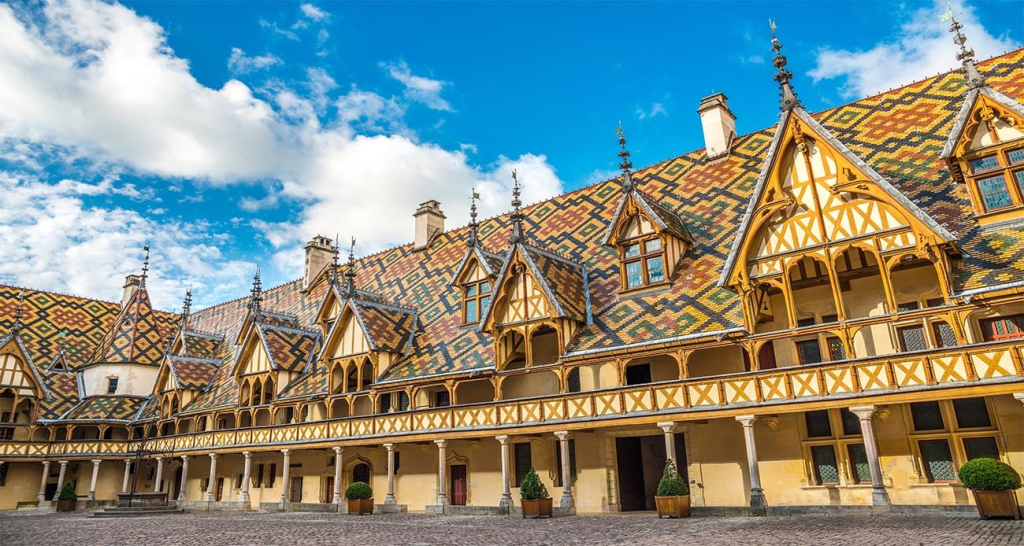
The Hospices of Beaune are the jewel in Beaune’s crown. Founded by Nicolas Rolin in 1443, the Hospices de Beaune were alms-houses, built to offer charity to the poor after a period of bad harvest and the economic damage caused by the Hundred Years War. The Hospices de Beaune was a self-sufficient charity, raising money via the sale of grands and premiers crus wine, produced on vineyards it owned nearby, to treat the infirm and feed the poor. Amazingly it was still in operation until the 1970s.
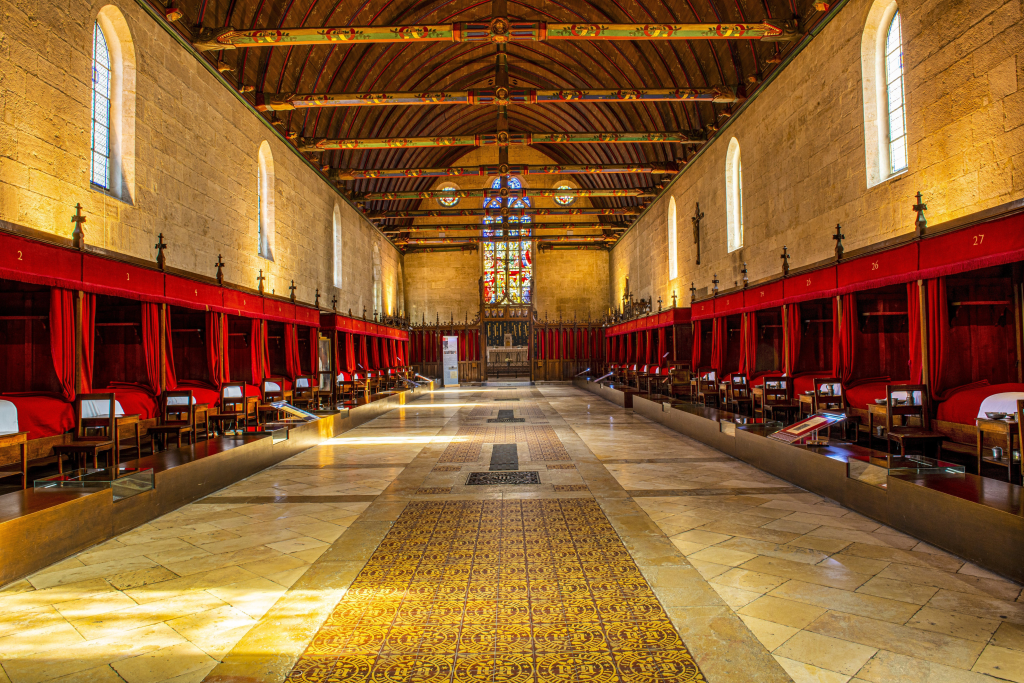
Nicolas Rolin used his vast knowledge of hospital institutions to make his Hôtel-Dieu (Hospices de Beaune) an establishment capable of spanning the centuries. A good negotiator, he placed it under the spiritual authority of the Holy See and freed it from all royalties. And as a good administrator, he endowed it with vineyards, farms and woods.
In 1457, Guillemette Levernier made the first donation of vines to the Hospices de Beaune – Hôtel-Dieu, a tradition that continued for five centuries. Today, the winegrowing estate is close to 60 hectares, 50 of which are devoted to Pinot noir and the rest to Chardonnay. Confined to 22 winemakers handpicked by the régisseur, this exceptional winegrowing estate boasts 85% premiers crus and grands crus, which are sold at auctions on the third Sunday in November. This sale, organized by Sotheby’s, is the most famous wine charity sale in the world.
It was Sunday evening and Beaune was heaving with tourists. We searched high and low for a restaurant that had a table for two available but everywhere was fully booked! In desperation, Claude disappeared into a butcher’s shop which doubled as a restaurant and got chatting to the proprietor. A few minutes later both emerged. The restaurant was fully booked, but the proprietor took pity on our plight and kindly led us down the street to a café where he secured us a table! It was time for a final glass of wine with Claude before he headed back to Brussels the next day.
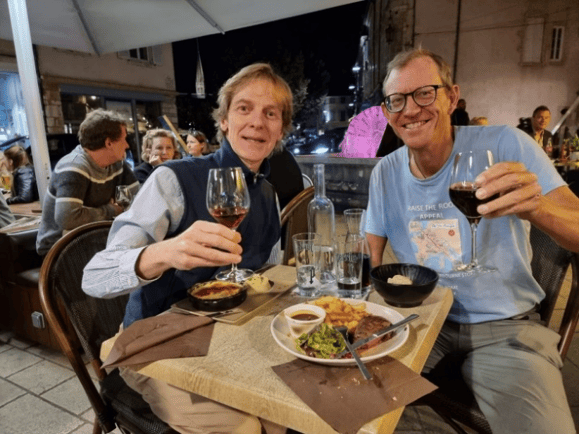
Back in our gite this evening, I couldn’t help thinking about Diderot and what his views might have been on ‘The Raise the Roof Appeal’ and my pilgrimage to Rome on the Via Francigena. I think it’s a fair bet that he wouldn’t have approved or been a major sponsor! As he once famously said:


Leave a Reply