How good the Church is in this century of hatred, Of pride and avarice and all sins, To hear today the hidden of the hidden, The meek among the meek to human ignorance.
Saint Benoit-Joseph Labre in Amour – Paul Verlaine
It proved to be an interesting and challenging day as the distance from Amettes to Béthonsart on the VF was 52 km! So I decided to go off piste and cut across country on the GR127 using my IGN 1:100,000 map and trusty compass as my guide to cut the distance covered by half.
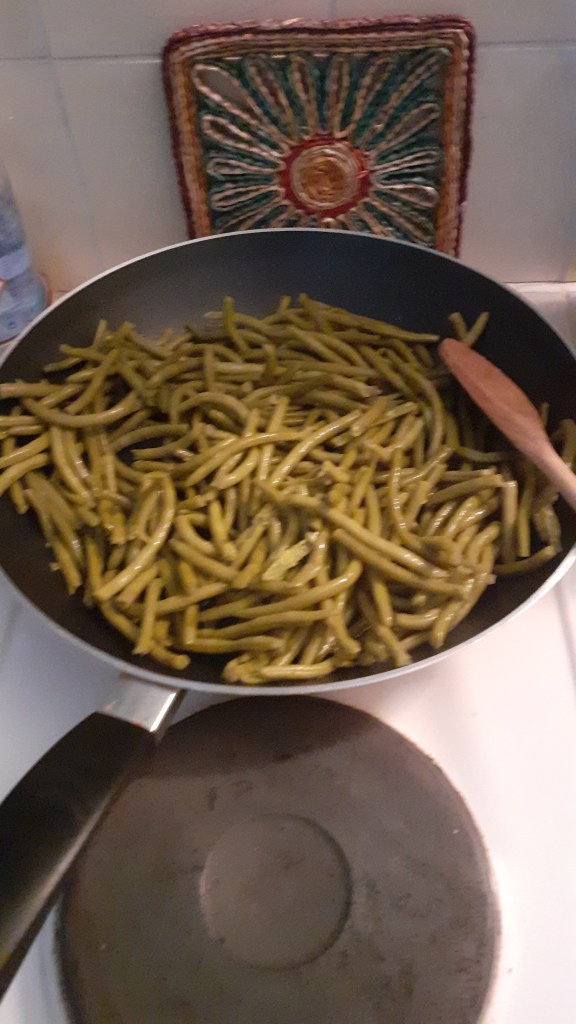
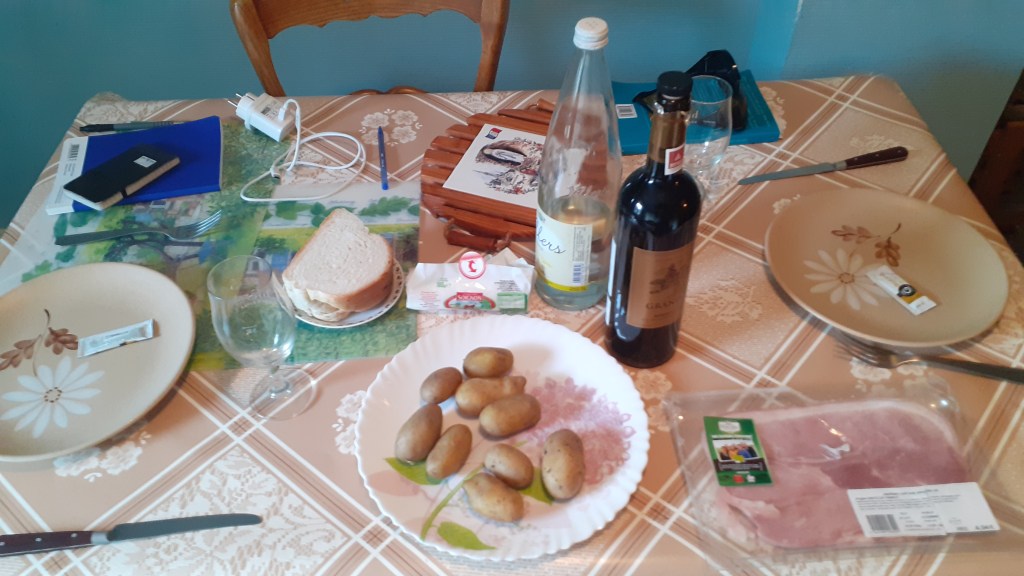
Dean from Seattle successfully made it to La Ferme des Tilleuls last night. It transpired that the ‘cooked meal’ advertised by our hosts required us to cook it! So we boiled up some spuds, heated up some tinned green beans and added some ham to the mix for a hearty supper washed down with some local wine which our host Colette produced for the occasion and then quickly disappeared.
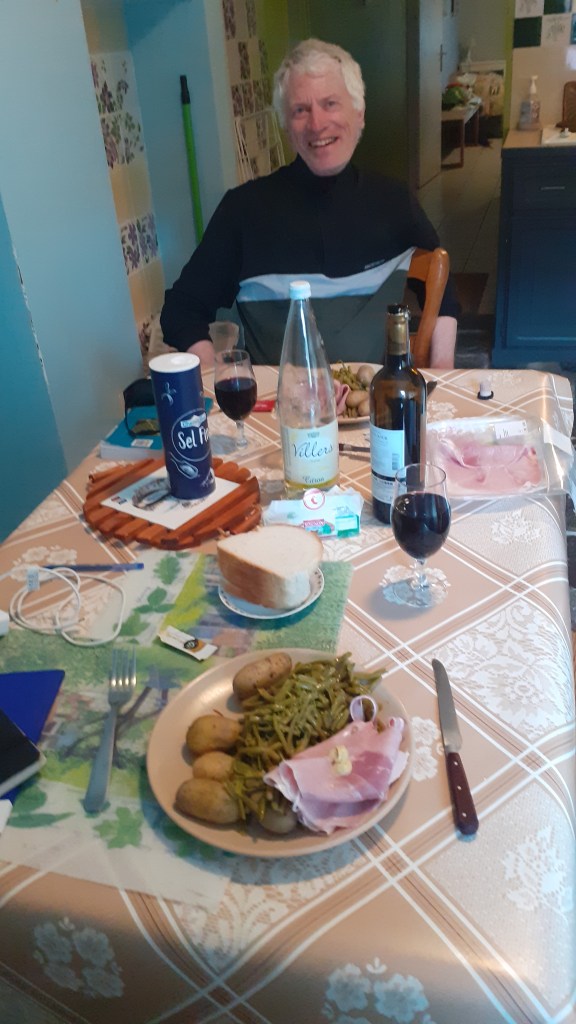
Sean and I enjoyed a jolly evening, discussing everything from Afghanistan and the impact of the ‘Domino Theory’ on American foreign policy in the 1960s, to American attitudes to gun possession and control and out travels in remote parts of the world. Sean had travelled widely in Europe ( his grandparents were Swedish) and Latin America ( Sean had spent time in the Peace Corps in Paraguay) as well as hiking the entire length of the Appalachian trail in the US which is no mean feat!
He had also worked for a number of years as an archaeologist in the US. This was also a hobby of mine – during summer university vacations I worked on a number of dogs around the UK as well as signing up to go on an expedition to excavate an Incan site in the Urubamba valley near Cusco in the Peruvian Andes, where the archaeologists kept their spirits up by chewing cocaine leaves!.
I regaled Dean with the story of my visit to meet the expedition leader, a mild mannered bespectacled lady in her early sixties who had an office in Gotdon Square. It was in the mid 80s when the Serendero Liminoso Maoist insurgents were particularly active in the Andes region near Cusco. ” If you hear machine gun fire while you are on the train ” the Expedition leader advised me, “just like down flat in your carriage and you will probably be ok”. It seemed like sound advice!
I enjoyed his company and was sorry to bid him farewell after we’d enjoyed breakfast together.

The previous afternoon, I’d visited the humble birthplace of Saint Benoit-Joseph Labre, the patron saint of pilgrims and the homeless. Born in 1748 as the eldest of 18 children of a farming family, Benoît-Joseph had from an early age felt drawn to a life of solitude and prayer. Thwarted in his attempt to enter a monastery and become a monk, Benoît-Joseph became a pilgrim, traveling from one great shrine to another and living off alms. He wore the rags of a beggar and shared his food with the poor. Aged 28 he ended his pilgrimage. In Rome, where he lived in the Colosseum for a time, and spent his time with the destitute of the city.

Rome’s citizens were soon telling stories about the young man. How he knelt in church and floated from the ground or burnt with a faint lustre as he prayed. How, in his hands, a single loaf of bread became two loaves, twenty, and he would give the bread away until there was nothing left for himself. Benoit-Joseph wanted to break free from desire, from need, but it made him frail. His knees swelled from praying the Forty Hours without rest. His stomach distended from constant fasting. On Holy Wednesday 1783, aged thirty-five, he collapsed during Mass at Santa Maria ai Monti. He was carried to a nearby house and given the last rites. That evening children ran through the streets shouting, ‘The saint is dead!’
His body was returned to the church and laid in repose. The crowds that gathered to mourn him were so large, a guard had to be posted at the door. And every other day another miracle: those who were sick and dying, who had lost their minds, prayed to the young man and were cured.
Accounts of those miracles spread round Europe. Within three months the newspapers in Paris and London were reporting on the beggar whom Rome was calling a saint. A little under a century later in 1881 he was canonized and feted in poetry by none other than Paul Verlaine, who along with Baudelaire and Rimbaud was one of the angry young men of late 19th century French poetry. Looking back at the era of Voltaire, Rousseau and Robespierre, Verlaine claimed that Labre was ‘the only light in France from the eighteenth century’.
As I wandered around Benoît Joseph Labre’s humble birthplace, I wondered what had driven him to a life of extreme poverty and pilgrimage and what, if anything, connected him to modern day pilgrims on the VF like myself. The eternal conundrum of how to live a Christian life without renouncing all your worldly wealth and follow the example of the likes of Benoît Joseph Labre who perhaps believed they were pursuing Christian doctrine to its logical and purest extreme.
I left Amettes by the Rue des Berceaux. There is no connection with the French word for cradle or birthplace (berceau).
‘Berceaux’ derives from the old French word for an archery field called ‘ bersaul’ and an old term for ‘ a target’. In the small square stood a thirty metre pole where small wooden cylinders called ‘birds’ were attached and proudly brought down by archers.
The origin of this form of shooting ‘ On the Pole’ came from the medieval hunting technique where archers would shoot at the enemy manning castle ramparts. The technique is still practised in the north of France, Belgium and Holland.
Colette, the proprietor of the Eden gite d’étape had kindly drawn me a map to guide me from Amettes to Béthonsart and helpfully indicated that there was a bakery in Floringhem. I duly dropped in to see what they had on offer for hungry pligrims.
In fact, there were so many goodies on sale that I felt like a kid on a candy shop. Tempting though it was to go on a carbohydrate Blitzkrieg, I resisted the temptation and restricted myself to a jam on sandwich.
Quite surprisingly, going off piste and navigating with the aid of a map and a compass wasn’t as arduous as I had feared.

The GR127 was well signposted and I seemed to be making decent progress towards Béthonsart. I sat down on a bench on top of a hill, surveyed the wonderful panoramic view of the surrounding countryside, and contentedly consumed my jambon sandwich!

The afternoon walk to Béthonsart proved somewhat more challenging, particularly when I reached the small hamlet of La Comté. Thankfully a kindly old gentleman, who could see I was struggling to find my way, stuck his head out of his car and told me to do a 180 degree about turn and return the way I had come!
‘Follow the Rue des Allobroges and head for the plateau’ he said, or at least I thought that is what he said. The path, he suggested I take, wasn’t actually shown on my map, but such was my faith in the old chap, that I trusted his advice and headed off in a south westerly direction.
Eventually I found my way to the farm in Béthonsart owned by my hosts for the night, Christine and Pierre-Yves Lamarliere.
After being shown my room, Christine gave me a tour of the farm and the church.
Béthonsart is a fairly small village (pop 150), and it quickly became apparent that everybody knew everybody else. Christine took me around the farm – they milk around 90-95 Holstein dairy cattle. They aren’t organic (because it doesn’t pay) but they have put solar panels on a number of the farm buildings and also sell bio gas back to the national grid from the waste generated from the cows.
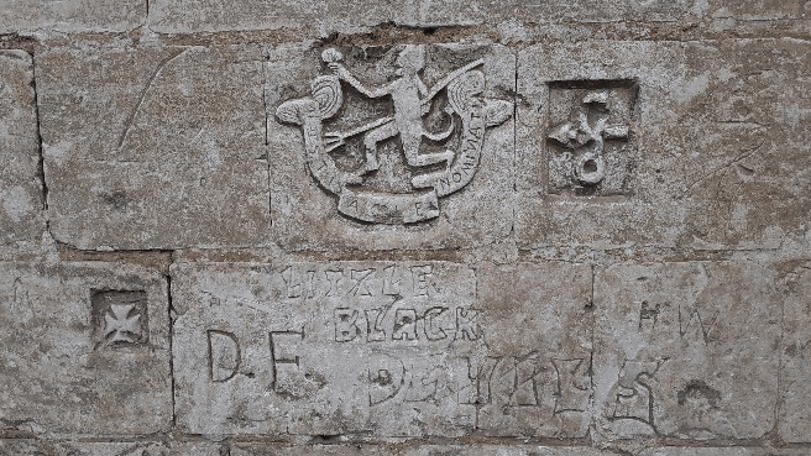
Christine them showed me the inscriptions left on the old farm buildings by Allied troops who were billeted on the farm during World War 1. The Royal Marines, the Duke of Cornwall’ Light Regiment and a number of Canadian regiments, including one nicknamed the Black Devils, had all inscribed their regimental emblems on the farm walls.
Then it was off to look around the 12th century village church with its magnificent tower, one of only ten surviving specimens in France. Inside were images honouring Joan of Ark, Benoît Joseph Labre, Elizabeth of Hungary and Thérèse of Lisieux.
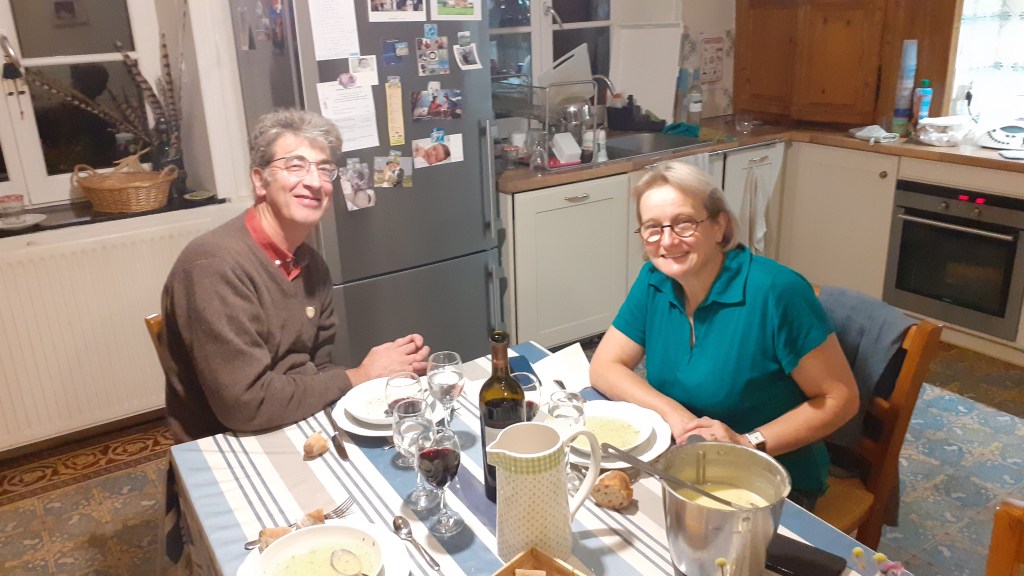
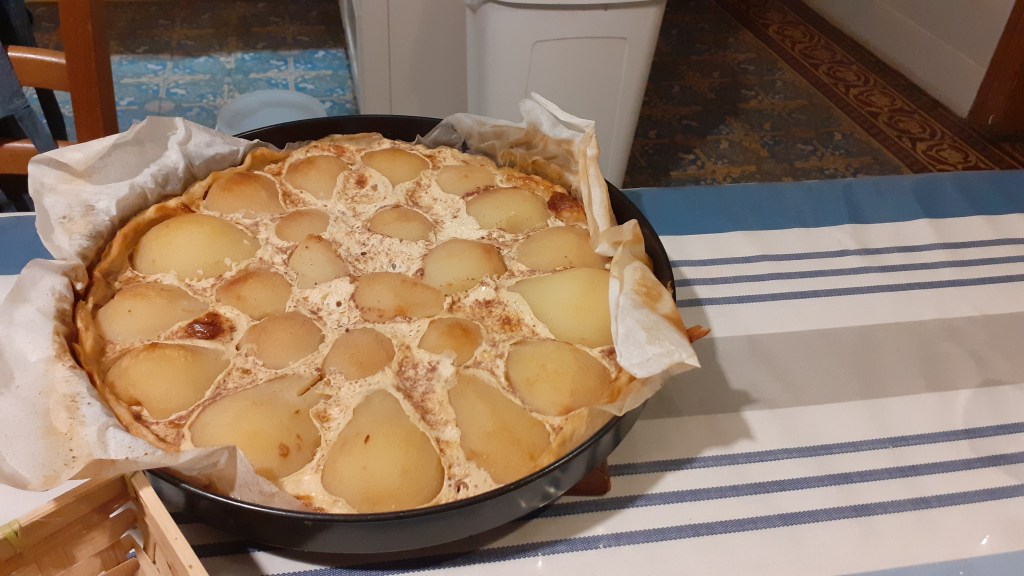
We finally sat down to supper after Pierre-Yves had come in from milking the cows. Christine, who also works as a business studies teacher in Lille, had somehow found the time to rustle up a delicious supper of homemade courgette soup, lamb chops, cheese and apple tart. They couldn’t have been more generous and hospitable hosts. I am glad to say that l’entente cordiale’ appears to be alive and well in this part of north east France!


Leave a Reply