Dirty British coaster with a salt-caked smoke stack,
Butting through the Channel in the mad March days,
With a cargo of Tyne coal,
Road-rails, pig-lead,
Firewood, iron-ware, and cheap tin trays.
‘Cargoes’ – John Masefield
As my alarm sounded at 5.45am I must confess that I wasn’t hugely optimistic about my chances of making it across the channel. I hadn’t even tried out the foldable bike that Mike had kindly given me, so had no idea about whether it would safely convey me the one mile from my AirBnb to the ferry without my coming a cropper!
Donning my high vis top ( as advised by Mike, so as to avoid being flattened by an HGV in the ferry terminal) I gingerly made my way downstairs, having attached my walking stick to my rucksack so that it resembled something akin to a prehistoric antenna.
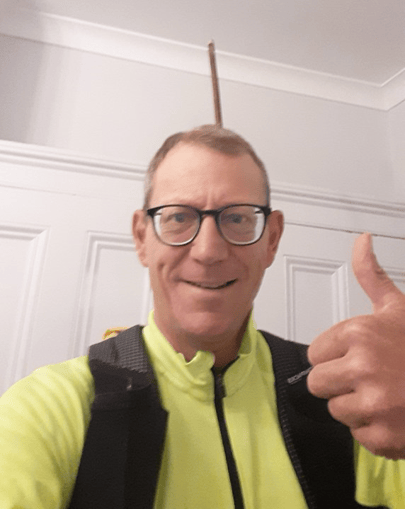
Having given the folding bike a quick spin in the deserted road in front of my AirBnb, I headed off towards the ferry terminal, the route to which I had cunningly recce’d the previous evening. Despite a few near misses with low hanging trees, I somehow made it through the ferry concourse in one piece and onto stand 189 where I waited to embark onto the 7.55am P&O Ferry.
It would be an exaggeration to claim that I was accompanied by a convoy of fellow pilgrim bicyclists. As far as I could see, I was standing in glorious isolation, the only bicyclist waiting to embark!
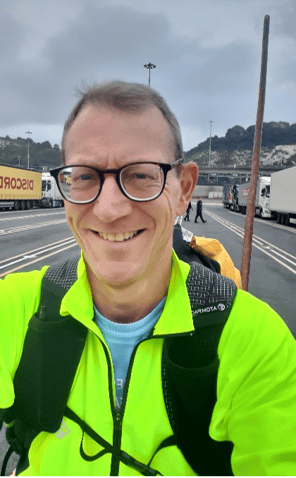
At this point Jeremy appeared. Jeremy, who was originally from Newcastle and whose father lives in Poitiers had set up a business exporting Japanese sports cars to France. It had apparently been a highly successful and lucrative enterprise until Brexit reared its ugly head and he had suddenly been clobbered with 20% export duties. I commiserated with him and shared my own experience of the impact of Covid and Brexit on our language school business. The law of unintended consequences.

Our conversation was abruptly terminated by the announcement that we were about to board! I was given the green light for go and manfully cycled up the ramp onto the ferry. Halfway up the ramp, my progress was checked when I realised that I wasn’t going to make it up the ramp in 3rd gear ( yes, mirabile dictu, the bike had gears!) So after a nifty gear change into first, I safely made it onto the ferry, and immediately hared up the stairs in search of another ‘Full English’.
One of the strange features of my walk so far, has been the uncanny number of ‘chance’ events that have taken place. Call it serendipitous if you will, but another one occurred on the ferry crossing today.
As I was waiting patiently in line to order my ‘Full English’, a couple of gentleman who were ahead of me in the queue, struck up conversation with me and asked if I was a pilgrim. I answered that I was walking along the Via Francigena to Rome to raise money to restore the church roof of St Peter’s Winterbourne Stoke, of which I was the Treasurer, and my wife, churchwarden. At this point I was nonplussed to hear them ask the chap at the checkout to include my ‘Full English’ on their bill!
I joined them at their table and we struck up conversation. The elder of the two gentleman ( who were brothers) was Luigi and his younger brother was Riccardo. Luigi was planning to walk the Via Francigena, so was fascinated to learn more about my endeavour.
Luigi and Riccardo own and run a chain of Italian restaurants in London called ‘Spaghetti House’. They were on their way to see their family and friends in Mergozzo in the Piedmont region of Italy. Their father had originally come to England in the 1940’s and had worked as a butler at Milton Lilbourne Manor near Pewsey. When I mentioned that I had close friends in Milton Lilbourne who would probably have known the family their father worked for, Luigi and Riccardo’s interest was piqued!
Coincidence then followed coincidence! Their 92 year old father lives in Norfolk at Dersingham near Sandringham. I mentioned that my wife had at one time worked in a goldmine in the Yukon with a member of the Coke family who own Holkham Hall. It transpired that Luigi and Riccardo were keen fieldsportsmen and that their particular passion was dry fly fishing on chalk streams including the Test, Itchen and Nadder. It turned out that Riccardo had recently been fishing the same beat of the Test ( although on the opposite bank) as I had! It really doesn’t get any more unlikely than that!


On arrival at Calais, I was somewhat bemused not to be frog marched to customs control and asked for my passport/proof of Covid vaccination. Instead a couple of ‘jolie’ young female French gendarmes in a van, ushered me out of the port and pointed the way into Calais. The Lord moves in mysterious ways!

Miraculously the weather seemed to have undergone a fundamental change during our 24 mile Channel crossing. The clouds had entirely disappeared and the mercury had risen a good 10 degrees. My heart bled for the hundreds of thousands of UK staycationers valiantly waiting for the arrival of the much heralded ‘Barbeque Summer’.
It seemed prudent to get full value from my trusty steed before abandoning it, so I cycled into Calais which is blessed with a lot of bicycle lanes. Nobody seemed in the least bit surprised to see somebody cycling around Calais on a rickety bike in a yellow high vis top, a ruck sack and a thumb stick. Maybe that is what they call ‘Sang Froid!’.
For over 200 years from 1347-1558, Calais and the surrounding 20-mile perimeter of land called the Pas de Calais, was English territory. Nowadays little remains of the English occupation. Calais was finally retaken by the French in 1558, and Queen Mary is said to have famously exclaimed on her death bed, ‘When I am dead and opened, you shall find ‘Calais’ lying in my heart.’
Tempting though it was to hang on to the bike and ride it all the way to Rome, I decided this wouldn’t be in the spirit of the charity walk, so I reluctantly decided to abandon it at Blériot beach – the spot where Louis Blériot set off on the first flight across the Channel in July 1909.
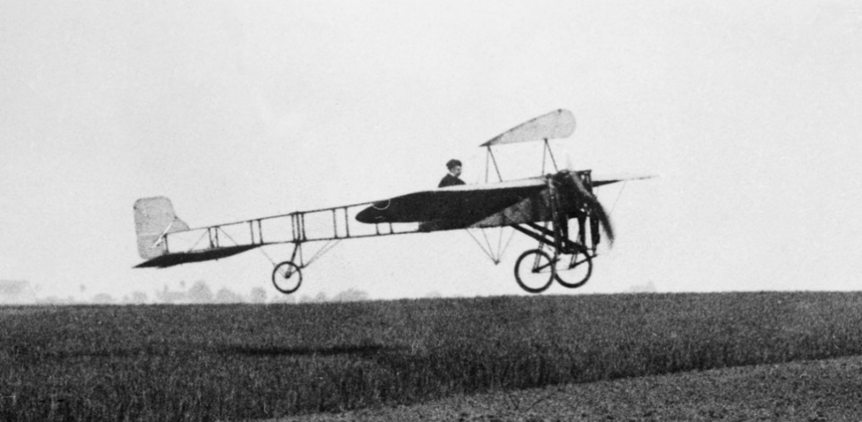
Early in the morning of July 25th, 1909, Louis Blériot crossed the English Channel, from Les Barraques (near Calais) to Dover. There had been longer flights and further flights, but the conquest of the Channel by air was a sensation and brought Blériot instant fame. Blériot had been a successful manufacturer of automobile headlamps who became fascinated by aeronautics in starting in 1901. He brought his latest aircraft to Les Barraques, the Type XI, a little monoplane fitted with a 25-horsepower, 3-cylinder Anzani motor. The London Daily Mail had put up a £1,000 prize for the first airplane flight across the Channel, and Blériot was competing to win the prize against two other aviators, Hubert Latham and Charles de Lambert. Lambert, who received his training from Wilbur Wright, had been injured in a test flight and was out of the running. Latham had already attempted a Channel flight – he had made it halfway across the Channel in his Antoinette IV monoplane on July 19 when engine failure brought him down in a forced landing in the sea. On the morning of the 25th, Latham was ready for another attempt with a replacement aircraft but was still fast asleep when Blériot took to the air. The flight took 36 minutes, 30 seconds, and was not without suspense. Blériot had also been injured in a test flight and was in pain with a badly injured foot. The photograph above, taken just before the flight, shows the strain that Blériot was under. It began to rain, and Blériot feared that the moisture would cause the Anzani to pack it in. The weather became turbulent, and visibility declined; he later recalled thinking – ‘I am alone. I can see nothing at all’. At Dover, the wind nearly caused him to crash, and his landing gear and propeller were damaged. But he had made it, and he was declared the winner. It was the first successful flight by an airplane over a large body of water. Hubert Latham was not happy when he finally woke up.
Tempting though it was to hang on to the bike and ride it all the way to Rome, I decided this wouldn’t be in the spirit of the charity walk, so I reluctantly decided to abandon it at Bleriot beach – the spot from which Louis Bleriot completed the first flight across the Channel in 1909.
The rest of the day passed relatively uneventfully. I kicked off my boots at Bleriot beach and walked along the beach to Sangatte. After an hour’s walk along the cliffs to Cap Gris Nez, I rejoined the beach, kicked off my boots once more and walked through the surf to Wissant. There wasn’t a cloud in the sky, the beach was largely deserted apart from the occasional kite surfer, and life felt good!
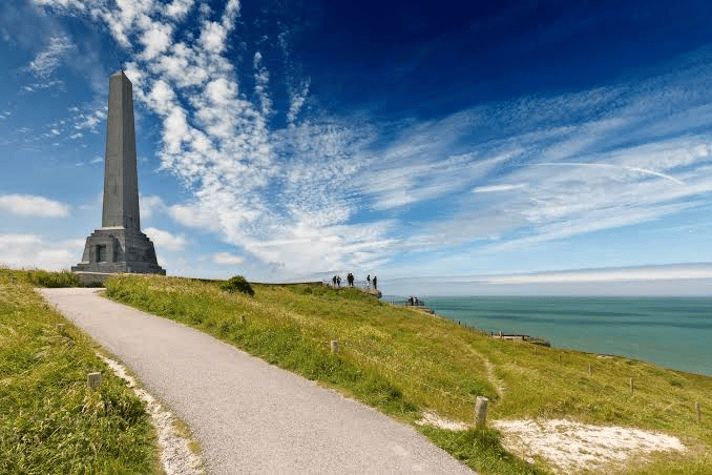
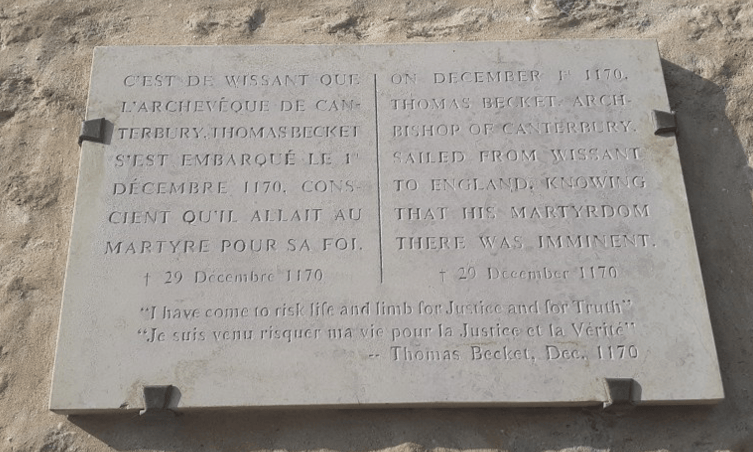
Wissant which means white sands and is on the Cote d’Opale, has quite a few claims to fame. It is believed to be the spot from which Julius Caesar in 55 BC and William the Conqueror launched his invasion of England in 1066. It was the place from which Becket sailed from France in December 1170 knowing that his death was imminent – commemorated in a plaque on the side of the church in Wissant. ‘I have come to risk life and limb for Justice and for Truth’ Becket is reputed to have said before he set sail from Wissant on the 1 December 1170. Less than a month later he had been brutally bludgeoned to death in Canterbury Cathedral.
Wissant is famous for its flobarts and its artists. A flobart is a shallow draught boat used in Wissant to fish for plaice and flounder. Until the 1950s, the flobart was used for rowing and sailing. Its rigging consists of a one-third main sail, called a purse, a one-third rear sail called a malet and a jib on the bowsprit (a pole that extends forward from the bow of a sailing ship). The flobart is constructed of elm, except for the oak keel. The planks which make up its hull are superimposed in a similar way to roof tiles (a “clapboard” construction). The flobart’s length ranged between 3.5 m to over 6 m. The flobart is a versatile boat, which enabled fishermen to do several things. Its large volume due to its pot-bellied shape made it possible to carry a large length of nets or a large number of traps. The flobart can float in only 30 cm of sea water. today there is only one flobart worked by a professional fisherman, all the others are owned by boaters or associations. Last weekend was the annual flobart carnival, when the entire town celebrated its maritime history.

With the construction of the Calais-Boulogne railway line in early 1867, this enabled a new generation of French travellers to discover the beauty of the Baie de Wissant in much the same way as the Newlyn School of artists flourished in Cornwall during the same period. Between the late 19th century and the early 20th centre, a group of French artists arrived in Wissant. They shared a love of the land, the light and the sea at Wissant. This group of artists came to be known as L’ecole de Wissant. They included Virginie Demont-Breton and her husband Adrien, whose paintings reminded me very much of the paintings of Laura Knight who was a member of the Newlyn school of artists.

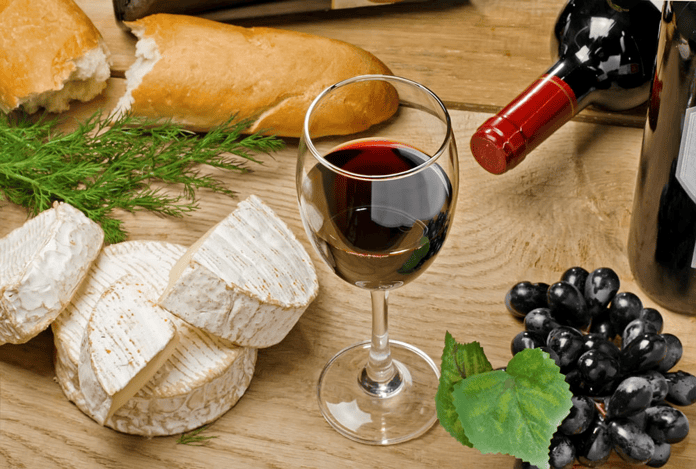
Yes, it was good to be back on the Continent again I thought to myself as I wandered around the Friday market in Wissant. I wondered what to buy for supper. It was time for a bottle of red wine, a baguette and some camembert from the cheese stall in the main square. Why not after all I’d had The Full English for breakfast. What better way to finish off my first day in France? Start as you mean to carry on, as the old saying goes!


Leave a Reply