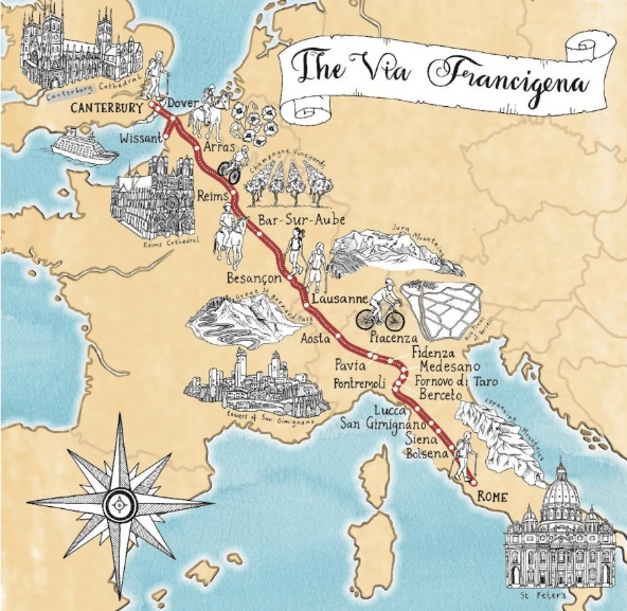
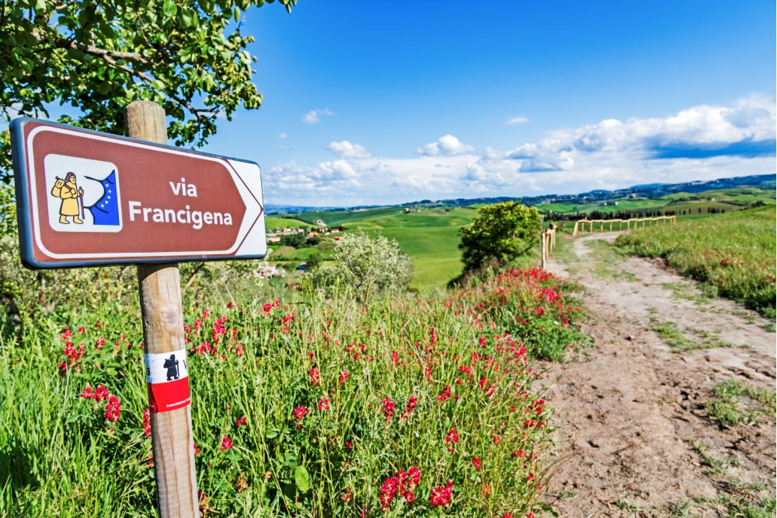
The Via Francigena, the route that has linked Canterbury to Rome since the earliest of times, is a virtual straight line in a south-easterly direction – as you might expect any journey between two points, especially when, for much of the last two millennia, a round trip, undertaken on foot or horseback, lasted the best part of two months. The Via Francigena was never an established road as such, it was more a corridor of movement along which merchants traded, armies marched, embassies moved and pilgrims travelled. It is incredible, however, that despite the invasion of Britain by Julius Caesar in 55BC, St Augustine’s arrival in 595 or the thousands of others who must have travelled up and down it for whatever reason, the first recorded itinerary of the Via Francigena was made by Sigeric the Serious, King Aethelred the Unready’s Archbishop of Canterbury from 990 until his death in 994. Sigeric was luckier than one of his predecessors, Aelfsige (or Elfsy), who froze to death in the Alps while making the same journey.

Forgotten for the significant role he played in attempting to save the country from repeated invasion by the Danish King, Sweyn Forkbeard, Sigeric is today remembered almost solely for the fact that he happened, probably out of boredom, to write down the 80 or so places where he stopped on his return to England from Rome after being officially invested with the pallium, the scarf-like vestment worn around the neck and effectively, the Archbishop’s badge of office, given to him by the Pope. His account is nothing more than a list- no year, no date, not so much as a remark, indeed some of the places he recorded confound historians to this day. Nonetheless, it is on this unremarkable document, found in the pages of an Anglo-Saxon Miscellany in the depths of the British Museum, that the present route of the Via Francigena is based.
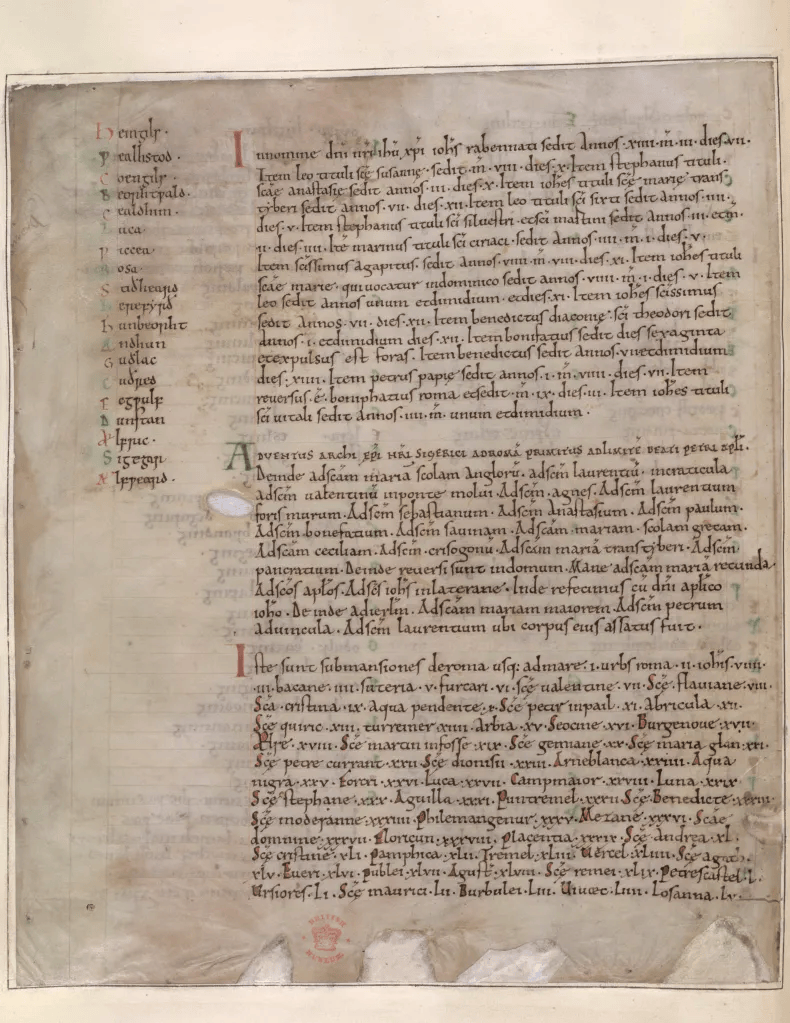
Not a huge amount is known about Sigeric. It’s believed he was born sometime around 940 or 950 and educated at Glastonbury Abbey where he took holy orders. He was elected Abbot of St Augustine’s in about 975 and consecrated by Archbishop Dunstan as Bishop of Ramsbury in 985 before being transferred to the see of Canterbury in 990. His connection to Glastonbury was significant because this was the centre of the 10th century monastic reform movement initiated by Dunstan, reforms which Sigeric continued after his elevation to Archbishop.
Apart from his journey to Rome, the most notable event that the Anglo-Saxon Chronicle records during his short tenure as Archbishop of Canterbury was his advice in 991 to the King, after the disastrous defeat of the English army at the Battle of Maldon, to try and bribe the Vikings from further attacks with a tribute of £10,000. This subsequently became known as the Danegeld. Sadly, the ploy backfired disastrously. Two years later in 993, the Danes were back for more booty, attacked London with 94 ships under their leader Svein Forkbeard (who was later to successfully invade England in 1013 and become King for a year before his death in 1014), proceeded to invade and occupy much of Wessex until they were again paid off with tribute of £16,000!
The popular image of the Christian pilgrim dates back to the Middle Ages, celebrated most notably in Chaucer’s fictional story of a band of everyday characters on their way from Southwark to visit the tomb of St Thomas à Becket, England’s premier shrine in The Canterbury Tales. To give an idea as to how popular the pilgrimage was around that time, over two million people were believed to have flocked to Rome from all over Europe in 1300 and, in 1450, it was estimated an astonishing 40,000 people a day were pouring into St Peter’ Basilica. This was at a time when the total population of England was somewhere between four to five million people!

St Wilfred of Hexham and St. Benedict Biscop (founder of the twin monasteries of Monkwearmouth and Jarrow) were the first named English pilgrims to make the journey to Rome, in the mid-seventh century; others included Alfred the Great, sent by his father, and King Canute. The rich would make the journey on horseback, passing from bishop’s palace to bishop’s palace, while the poor would travel on foot from monasteries and convents to hospitals run by religious orders. Despite the renewed popularity of the Camino de Santiago, never since has the Christian pilgrimage on foot enjoyed such a following as it did in the latter half of the Middle Ages – perhaps due to war, time, the effort required or the inescapable fact that nowadays the Church, in general, plays an ever-smaller role in Western society. By comparison, today, less than a handful of Britons walk to Rome every year. I was hoping to be one of them.
Pilgrims had been travelling to far-off places well before the Middle Ages, in search of saintly relics – including many fakes too – to pay homage to holy bits of finger, skull and other obscure pieces of this and that which they believed, in visiting, brought them closer to God either by touching or – worse – drinking, in the hope of making a prayer come true, curing sickness and disease or plain bolstering up virtue. To die a saint meant almost immediate dismemberment, as your various body parts were scattered across Christendom, like new exhibits at the Royal Academy – a piece of Becket’s bone even ended up at the Venerable English College in Rome. The only others who suffered a similar fate were criminals after they had been executed.
Such was the clamour to get sight of these relics, like the Veil of Veronica – the cloth that the saint is said to have wiped Christ’s face with – that people were frequently crushed to death in the melee. Pilgrims, effectively religious tourists, were good for business; the enormous numbers of the devout on the move all needed to be housed, fed and watered – revenue from pilgrim dues helped to rebuild Canterbury Cathedral after it burnt down in the 12th century. And, at a time when Christianity was the framework for everything, to go on pilgrimage was to embark on the journey of a lifetime and a much sought-after opportunity to earn, in the process, a few bonus points (in the form of Indulgences) to present at the Gates of Heaven to forego temporal punishment due on sins forgiven. This was all the more important, given the ghastly prospect of Hell, as peddled from the pulpit every Sunday, was worth avoiding at all costs.
Another compelling reason for anyone to go specifically to Rome was the reward of forgiveness from all sin; this sounded particularly attractive to me – the chance to wipe the slate clean after a far from angelic 57-year sojourn on this earth! Of course, I would just have to try and avoid the fate of Archbishop Aelfsige who froze to death at the Great Saint Bernard’s Pass while crossing the Alps en route to Rome in 959!
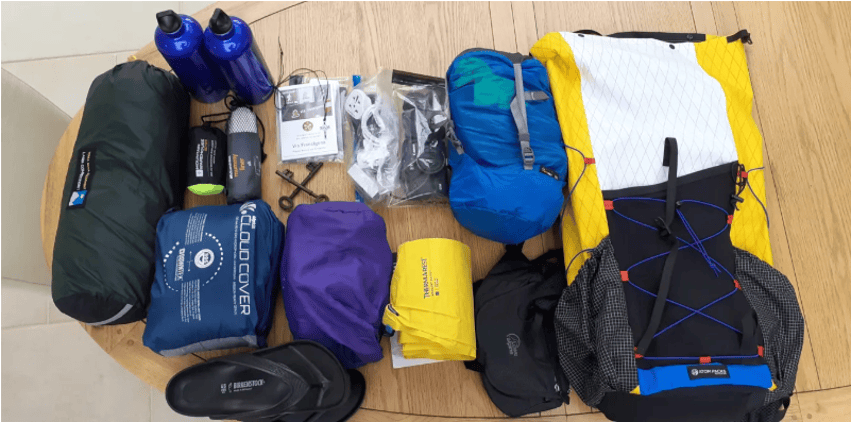
In the end I decided I wouldn’t need an ice axe and snowshoes to avoid meeting Archbishop’s Aelfsige’s fate. Instead, I opted for ultralightweight clothing and camping gear including a one-man tent, much of which was recommended to me by Brian, a veteran of Europe’s pilgrim routes who by chance lived in the neighbouring village of Shrewton some three miles away! A visit to Cotswold Outdoors in Salisbury to buy some lightweight Meindl boots proved something of a revelation. My feet were measured this way and that, I was made to stand up, sit down, walk on the flat, walk around and even walk down a slope. The upshot of it all was that I discovered that for the last 30 years I had been wearing boots that were a size too small and that this was what had historically caused me so much grief in the form of blisters!
In order to restrict my backpack weight to under 5kg, I cut my kit and caboodle to the bare minimum required for a four month walk from Wiltshire to Rome. I permitted myself the luxury of a spare pair of merino underpants, a bar of Savon de Marseille soap (which would multifunction as a clothes wash and shampoo!), a plastic plug (in case I ever stayed in accommodation with a bath) and a multiblade penknife with a corkscrew. (essential when travelling across France!) Other creature comforts, such as a pocket radio or a pair of loafers, were sacrificed on the altar of expediency!
With me I took a pilgrim staff, in the form of a Northumbrian thumb stick, a pair of cast iron keys to represent the keys of St Peter to the Gates of Heaven and a crucifix from Pluscarden Abbey that Harry Bucknall sent me to keep me safe on my journey. By the beginning of August, I felt I was as ready as I would ever be for my epic adventure. Now all I needed was for the UK government to relax the Covid travel restrictions and find a way of getting across the Channel at a time when foot passengers were prohibited from travelling on cross Channel ferries. My pilgrim neighbour Brian was upbeat about the obstacle presented by P&O Ferries’ no foot passenger policy. ‘Don’t worry’, he advised me breezily, ‘Pilgrims always find a way.’
When I outlined my plans to friends and neighbours their response varied from the incredulous to the cynical. Questions ranged from ‘What, have you suddenly got religion then?’ to ‘I suppose you’ll be walking there with some chums then’. When I responded that I was going to walk without any companions and that I hadn’t, as yet, undergone a Damascene conversion, they were even more dubious about the viability of my project. Who knows. Maybe the Herculean task on which I was about to embark was indeed nothing more than a midlife crisis!


Leave a Reply